Judge Dismisses UG’s Tort and Statutory Claims Against Countrywide

Round one in the Battle of the Titans has gone to Countrywide. On October 6, 2009, the Central District of California handed down its decision on Countrywide’s (now part of Bank of America) Motion to Dismiss in the case of United Guaranty Mortgage Indemnity Co. v. Countrywide Financial, et al., holding that United Guaranty’s (a subsidiary of A.I.G.) tort and statutory claims would be dismissed, and only UG’s claims based on breach of contract and breach of the implied covenant of good faith and fair dealing would survive. The full order is embedded below.
Each of Countrywide, the nation’s former number one lender, and A.I.G., the nation’s largest insurer, have filed lawsuits against one another in the Central District of California (UG filed a third case in federal court in North Carolina, citing forum selection clauses) All eyes are on these cases as a bellweather for future decisions in subprime mortgage litigation, especially litigation related to mortgage insurance. This Order is one of the first to tackle head-on some of the thornier issues surrounding who will bear the losses associated with the mortgage meltdown.
Judge Mariana Pfaelzer’s opinion takes the time to walk through the securitization and mortgage insurance acquisition process, and determines that both UG and Countrywide were sophistocated parties that had substantial experience in securitizations and mortgage insurance policies, despite UG’s arguments that it had “limited experience in the subprime market.” In doing so, the Court showed a willingness to take judicial notice of language in the Policy regarding the parties’ assessment and allocation of risk that it found to contradict UG’s allegations. While ordinarily, for the purposes of a motion to dismiss, a court must accept as true all properly pled allegations of material fact, the Court cited the recent Supreme Court case of Ashcroft v. Iqbal, 129 S. Ct. 1937, 1949-50 (2009) for the proposition that the court need not accept as true “unreasonable inferences” when the complaint is read together with the underlying documents (i.e., the insurance policy and commitment agreements).
In my initial analysis of these cases, I noted the dichotomy between UG’s assertions that it was relatively inexperienced in subprime mortgage insurance and Countrywide’s assertions that UG was a sophisticated market actor in this area. It appears this battle has been decidedly won by Countrywide, with the Court finding that UG negotiated a sophisticated contract that contained remedies for fraud and negligence, and that UG had the means and the knowledge to conduct due diligence on Countrywide’s loans prior to insuring them. These findings seemed to be important factors in the court finding that UG’s claims for fraud and negligence must be dismissed, and that it must pursue contract remedies for any such findings.
The opinion also discusses the concept of delegated underwriting, standard in the mortgage insurance industry, in which the insurer delegates the responsibility for properly underwriting the loans it insures to the lender, which represents and warrants the loans were underwritten properly. In return, the insurance company retains the right to audit the loan files to determine whether they were indeed properly underwritten. This structure is often necessary due to the lender’s superior access to information and the short turnaround time available after the loan is closed but before it is sold into securitization.
Judge Pfaelzer noted that this “delegated model makes sense when engaging in bulk mortgage insurance transactions: the applicant represents material information about the mortgage, then the insurer prices and issues the policy based on that information.” However, her Order goes on to find that, “any reasonable mortgage insurer that (1) was doing multibillion-dollar bulk transactions and (2) had an express right to audit or sample the underlying loan files before the transactions closed, would engage in some degree of auditing or sampling of the underlying loan files to be insured.” Thus, the Court found that UG could not have reasonably relied upon any misrepresentations Countrywide may have made to induce UG to provide insurance.
The Court also discredited UG’s “global rescission” argument – that these misrepresentations as to some loans entitled it to rescind coverage as to all loans in a pool. Thus, to succeed in its case, UG will have to go forward on its contract claims and demonstrate, on a loan-by-loan basis, that Countrywide breached the terms of the policy or commitment agreements for each.


AIG-Countrywide Court Order re Motion to Dismiss

Posted in Uncategorized | Leave a comment

U.S. Regulators Chastise Banks on Loan Modifications; Political Tide May Be Turning on Home Loan Servicers

Servicers of home loans have thus far enjoyed preferential treatment by regulators in the shakeout from the recent financial crisis, but that may all be changing.

On August 13, U.S regulators issued a joint statement to residential mortgage servicers warning them that “[a] servicer’s decision to modify the first lien mortgage should not be influenced by the potential impact of the modification on the subordinate loan and vice versa.” The statement was issued by the Federal Financial Institutions Council, an interagency group that includes the Fed, the FDIC and the Office of the Comptroller of the Currency, among others. The regulators further noted that entities servicing both first and second loans on the same property “may be faced with potential conflicts of interest when making loan modification decisions,” and that the failure to modify loans in cases that would produce a greater anticipated recovery for owners and investors, “may be a breach of the servicers‘ obligation to those owners/investors.”
Until recently, it appeared that residential mortgage servicers–often the very same banks that had issued the loans that borrowers are now unable to afford–were the favored sons of this nation’s regulators. First, Bank of America/Countrywide was allowed by state Attorneys General to saddle investors with the lion’s share of an $8.4 billion settlement stemming from its irresponsible lending practices. Then, servicers were given a Safe Harbor and cash incentives to clean up their problematic loans when Congress passed the Helping Families Save Their Homes Act back in May of this year.
However, a letter issued by congressmen Christopher Dodd and Barney Frank on July 10 signaled a shift in the way regulators viewed home loan servicers. This letter, which was sent to the Fed, the FDIC and the Office of the Comptroller of the Currency, among others, was the first acknowledgment from Congress that servicers may have been resisting performing the loan workouts needed to stem the foreclosure crisis because they were the foxes guarding the henhouse. Though industry experts and commentators have recognized servicers‘ conflict of interest stemming from their own holdings for months, this letter may have been the first to alert the Federal Financial Institutions Council that servicers were acting in their own interests, not those of the borrowers or bondholders servicers were contractually obligated to further.
Also contributing to this shift in momentum was the release by the Treasury Department of its first monthly progress report on its plan to aid homeowners through loan modifications. This report found that just 9% of eligible homeowners have received trial modifications. The Treasury also released a breakdown on modifications by home loan servicers, which showed that none of the Big Four servicers (Wells Fargo, Citibank, BofA and Chase) had modified more than 20% of the loans eligible.
Officials from the Obama administration already met with mortgage servicers last month to encourage these companies to double the number of borrowers receiving aid. However, as this was before the Treasury released its numbers, I expect the frequency and intensity of such meetings to increase over the coming weeks. As those who have followed this blog are aware, I believe it is high time to acknowledge the role that banks (and now servicers) have played in fomenting the current financial crisis, and force those entities to pay their fair share to help clean up this mess.
Posted in banks, Barney Frank (D-MA), Christopher Dodd (D-CT), conflicts of interest, Federal Reserve, Helping Families Save Homes, junior liens, loan modifications, regulation, Treasury | 5 Comments

Article on William Frey, Countrywide and the Servicer Safe Harbor Published in Lombard Street E-Journal

I am excited to report that FinReg21, a leading website on financial services regulation, has published a feature-length article by me, entitled Why Should Servicers Get a Safe Harbor? How One Investor’s Lawsuit Forced Bank of America to Seek Shelter in Washington, in its Lombard Street e-journal. Lombard Street is billed as “the first e-journal focused exclusively on financial services regulation in the 21st century.”

The article tells the story of William Frey and Greenwich Financial Services’ (“GFS”) legal challenge to Countrywide’s settlement with the Attorneys General, and how this lawsuit spurred the passage of the Helping Families Save Their Homes Act by Congress. The article pulls together many of the facets of this story that we have followed on The Subprime Shakeout, from the cycle of securitization that led to the subprime mortgage meltdown, to Washington’s push for loan modifications that led to Countrywide’s $8.4 billion settlement with Attorneys General from over 30 states, to the litigation and legislation that followed.
The last two sections of the piece go further, however. In the second-to-last section, I provide a legal analysis of how the Servicer Safe Harbor could run afoul of the Fifth Amendment’s Takings Clause if it operates to deprive GFS and other investors of their claims against Countrywide and other loan servicers. In the final section, I offer an alternative solution to the mortgage foreclosure crisis that would be more efficient and equitable than the blunt strokes that Washington has taken thus far.
I look forward to hearing any feedback that readers may have on this proposal or any other aspect of the article. Thanks to Doug Winthrop, Christine Camp, and Michael Ginsborg at Howard Rice for providing skillful editing and insightful feedback, and to Charley Spektor, and Marilyn Cohodas at FinReg21 for supporting critical, non-partisan analysis on this and other issues affecting the regulation of financial services.
Posted in consitutionality, Countrywide, FinReg 21, Greenwich Financial Services, Helping Families Save Homes, legislation, litigation, loan modifications, Servicer Safe Harbor, William Frey | Leave a comment

In Letter to Bank Regulators, Senators Reverse Course

Loan servicers’ star may be quickly fading in Washington. In a stunning reversal of course, Representative Barney Frank (D-Mass.), Chairman of the House of Representatives Committee on Financial Services, and Senator Christopher Dodd (D-Conn.), Chairman of the Senate Committee on Banking, Housing and Urban Affairs, issued a letter last week urging bank regulators to investigate whether mortgage servicers are resistant to modifying loans due to the issues surrounding their holdings in second lien mortgages. The Senators accused the servicers of “unwillingness…to extinguish their liens as required for participation in [the Hope For Homeowners] program, even in return for offers of reasonable compensation.” The letter also suggested that servicers may be overvaluing these assets on their balance sheets, resulting in “inadequate reserving” that skewed the financial picture of banks in general.

This warning shot across the servicers’ bow comes less than two months after Frank and Dodd marched the Helping Families Save Their Homes (HFSTH) Act through Congress waving the flag of servicer safe harbor. Though the HFSTH Act had the goal of reducing residential mortgage foreclosures by encouraging loan modifications, the bill also featured a Servicer Safe Harbor provision that provided legal immunity and generous incentives to mortgage servicers (the four largest being J.P. Morgan Chase, Wells Fargo Bank, Citibank and Bank of America) to modify mortgages and extinguish second liens. In the process, the bill dumped the costs of the modifications on the investors holding these mortgages, despite the fact that servicers were also frequently the lenders that pumped out these troubled loans in the first place. Apparently, these incentives have not been enough to induce servicers to participate in Hope For Homeowners, as Frank and Dodd are now turning on the banks they fought so hard to protect.

At the outset of the foreclosure crisis, Frank and other congressmen heaped the blame on bondholders, such as Bill Frey, who had simply insisted on their contracts being enforced. Because investors refused to allow the terms of the mortgages backing their investments to be modified willy-nilly, they provoked the ire of the House Financial Services Committee.

In this letter to Frey, Frank and five other congressmen expressed outrage that Frey would oppose their efforts to modify mortgages, and “strongly urge[d]” Frey to reverse his position. They further invited Frey to testify, but when Frey took them up on their invitation, they changed their minds. Deprived of the chance to be heard, Frey wrote this letter to the congressmen instead, pointing out that servicers “have financial incentives to avoid foreclosure…even if it creates greater losses for the mortgage investor.” More recently, Frey wrote this scathing op-ed piece in the Washington Times, criticizing the Safe Harbor and breaking down in concise terms the conflict of interest inherent in giving servicers the keys to the modification henhouse.

Though Frank and his colleagues may not have wanted to listen to Frey at first, it seems that they’re beginning to realize that servicers have strong motives to act contrary to the interests of investors, borrowers, and the rest of the country. Why it took politicians with a supposed expertise in this field so long to really delve into this issue is beyond me, but partisanship and campaign finance may certainly have come into play (after all, the Helping Families Save Their Homes Act was introduced by two congressmen high on Bank of America’s payroll).

While I’m encouraged that legislators appear to finally be unraveling the complexities involved in cleaning up these toxic assets, I’m disappointed that their first solution was to shout and wave a big stick in the hopes of pushing through their “plan.” Fixing a problem of this magnitude involves understanding the players and what makes them tick, not bullying people into compliance. And it starts with a willingness to listen without bias, not a coddling of constituency.

Posted in allocation of loss, Barney Frank (D-MA), BofA, Christopher Dodd (D-CT), Helping Families Save Homes, Hope For Homeowners, investors, loan modifications, Servicer Safe Harbor, William Frey | Leave a comment

New Evidence Shows Loan-to-Value Ratio Contributed Most Heavily to Mortgage Meltdown

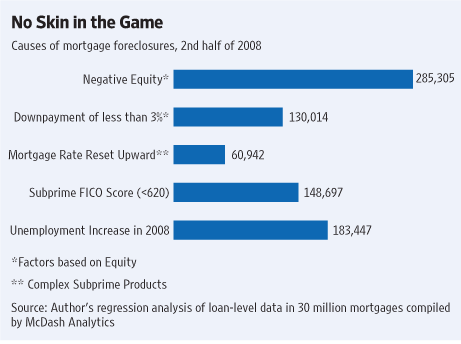
An article published in the Wall St. Journal this week by Stan Liebowitz posits a purportedly new take on the causes of the mortgage meltdown. Liebowitz’s analysis of recent data on millions of individual loans published by McDash Analytics, a component of Lender Processing Services Inc., compares the importance of several variables related to mortgage foreclosures. His conclusion? That the most important factor is whether the borrower has or ever had positive equity in the home (see graphic at right).

A borrower’s equity in a home is often expressed in terms of loan-to-value (“LTV”) ratio, or the amount of the first lien the borrower took out on the home compared to the appraised value of the home. So, if a borrower took out a $450,000 loan on a home valued at $500,000 (and made a $50,000 down payment), the LTV ratio on the mortgage would be 90%. An even better statistic is the combined loan-to-value (CLTV) ratio, which measures the amount of all loans taken out on the home compared to the value of the home, and thus includes second liens and HELOCs in the calculation. During the late years of the housing bubble, it became increasingly popular for borrowers to take out one loan on the first 80% of the value of the home, and a second loan for the rest, which meant that borrowers had no skin in the game, and often led to negative equity situations when housing prices crashed.
LTV and CLTV ratios were always one of the most important factors for gauging the riskiness of a loan. Thus, Liebowitz’s conclusion is not surprising. Borrowers with little or no equity in their home are much more likely to walk away from the loan when times get tough, whereas those who have put a significant amount of their own money into their home are more likely to try to work out a payment plan or put their home on the market. But from this rather unremarkable finding, Liebowitz attempts to proffer a much broader revelation and debunk the “common narrative” that subprime lending and stated income loans were significant causes of the foreclosure crisis.
While Liebowitz may be correct that the impact of subprime lending and stated income loans on foreclosures was more limited than the “common narrative” suggests, the truth is that this type of lending was symptomatic of the drastic loosening in underwriting standards that preceded the housing collapse of 2007. And, as Liebowitz recognizes, this loosening was enabled and fueled by a government- and Wall St.-backed campaign to artificially increase homeownership levels beyond where they should have been. If borrowers were really able to afford the homes that they were purchasing, they would have made sizable down payments so as to earn better interest rates over the life of their loans.
Instead, because the government was providing tax and other incentives to expand lending, Wall St. was making considerable profits from securitizing and selling these additional loans, and borrowers were happy to delude themselves into thinking that if they qualified for a loan, they could afford to own the home, this country experienced an explosion in irresponsible lending and borrowing that led us inevitably to the credit crunch we’re experiencing today. Subprime was a symptom of this unsustainable growth in lending and a symbol of the excesses this culture engendered. Ask yourself if you were a lender under ordinary lending conditions, would you give a borrower with a blemished credit record a loan for the full amount of the house, without requiring any down payment or an income tax return?
This is where Liebowitz and I, and most other experts on this subject, can most readily agree. Stronger underwriting standards are indeed necessary to return lending to the rational risk-assessment process it was intended to be.
The tougher issue is what to do about the current pool of “toxic assets,” backed by distressed loans, that are freezing up our credit markets. This solution is more nuanced and complex, and involves a loan-by-loan assessment. If the borrower cannot afford and could never have afforded the home, there must be a foreclosure. If the borrower was misled into the loan, the servicer should help effect a loan modification, the cost of which should be born by the lender or broker who acted in a predatory or fraudulent manner. And for everyone else who borrowed reasonably but who, due to the current financial crisis or a change of circumstances, cannot now afford to make their payments, we must decide as a society what makes the most sense.
If foreclosures are so costly that we’ve decided that society as a whole would benefit from large-scale loan modifications to reduce the foreclosure rate, then taxpayers should be prepared to foot that bill rather than sticking investors (or any other insular group) with the loss.
Thank you to Michael Ginsborg at the Howard Rice Library for passing along Liebowitz’s thought-provoking article – IMG.
Posted in allocation of loss, foreclosure rate, irresponsible lending, lending guidelines, loan modifications, loss causation, LTV, negative equity, stated income, subprime, toxic assets, Wall St. | Leave a comment