WTBTF Book Tour Day 2: Meeting, Marketing and Mentoring in Manhattan

I woke Tuesday morning, Nov. 8 on the second day of the Way Too Big to Fail book tour to the news that Kathy Patrick, legal architect of Bank of America’s Hail Mary Countrywide settlement (background here and here), had struck again.  This time, as disclosed in Morgan Stanley’s quarterly report, Patrick’s firm Gibbs & Bruns had sent a letter to the bank on October 18 on behalf of investors in $6 billion worth of Boom-era RMBS.

As of the writing of this post, the letter has not been made public, so I’m not sure if any particular investors behind it were named, but I would bet that two of the driving forces rhyme with Packrock and Blimco.  Only time will tell whether the settlement that will inevitably result from this effort will be as obvious a sham as the $8.5 billion settlement with Bank of New York that has now been diverted into Federal Court, but applying the same settlement calculation to the original face amount in this new case would mean about $120 million in potential damages for Morgan Stanley (zzzzzzz……).

There was little time to digest this news, however, as I was out the door by 7:00 am that morning to head into the Greenwich Financial Services’ offices to write more note cards (see part I in the WTBTF book tour series) and sign copies of the book before taking Metro North from Greenwich, CT into Manhattan for a full day of meetings.  I had finally managed to get a decent night of sleep, but it wasn’t nearly enough to recover from my redeye flight the night before.  It’s these sorts of mandatory caffeine mornings that make me glad I’m not a Mormon.

I met Bill Frey at the Cornell Club again, and proceeded upstairs for our first meeting of the day – with publicist Peter Zorich.  Zorich, son of actor parents Louis Zorich and Olympia Dukakis, has worked in the television industry for twenty years, producing shows for the likes of Bill O’Reilly, Hannity & Colmes, and Dylan Ratigan, and most recently working for Bloomberg and MSNBC.

Zorich is now a media consultant, helping people like Bill and I gain exposure for our story and ideas through the medium of TV.  Zorich thought that Bill had a story that would interest many television producers—as the man who had been vilified as a financial predator for suggesting that mortgage contracts had to be honored and who was now being looked to as the only one with the knowledge and experience to rebuild mortgage finance.

For those unfamiliar with his story, Bill has been through hell and back since the first time he came out publicly against government-sponsored “solutions” to the mortgage crisis back in 2008.  Of course, Bill can now laugh at the fact that he was unceremoniously summoned before Congress by Barney Frank and five of his colleagues (see link to Appendix II of WTBTF here), and that 400 protestors showed up on his front lawn and dumped a load of furniture on his porch, but at the time I would imagine that these episodes were unnerving, to say the least.  Still, Bill’s financial independence allowed him to weather those incidents without fear of financial repercussion.  Today, in fact, Bill credits Frank for engendering the ultimate in unintended consequences – it instantly brought Bill notoriety as a bondholder advocate and attracted the attention of the international investment community.

Drinks at Bill’s Greenwich office are still placed on coasters that pay tongue-in-cheek homage to those days – bearing Bill’s picture with the word “PREDATOR” stamped across it in red (see picture at left).  The funny thing is that Bill’s message today is the same as it was in 2008—and we include as Appendices I and III in WTBTF the letters Bill wrote on this subject in 2008 for comparison—that loan modifications are a good thing for both investors and homeowners if open dialogue between the two groups is enabled.  Yet, the reception this message is receiving today is markedly different.

After the meeting with Zorich, I headed to a coffee shop in Midtown for my next meeting of the day – with an investment manager/analyst at a big New York hedge fund to whom I had been speaking since my earliest days of writing this blog.  The analyst told me that he was thrilled to be getting a copy of WTBTF, but that the thing he was most interested in reading was “how the hell the system got so f-cked up.”

He was less interested in reading about Bill and my proposed solutions, as he felt that the gridlock in Washington would prevent any meaningful reform, but he reiterated the refrain I had heard from many in the investment community – that getting the wheels of foreclosure turning again was essential to restoring investment in the U.S. housing market.  “It’s like an electrical circuit,” he said, “if the foreclosure process at the end is broken, the entire circuit is broken, originations will languish and the housing market will remain stagnant.  Fix the foreclosure process, and even though people may lose their homes in the short term, they’ll ultimately benefit from more affordable mortgages in the future for homes they can actually afford.”

Next up was Bloomberg reporter Jody Shenn, long one of the most respected journalists on the credit markets and mortgage crisis legal issues.  Jody and I had been discussing developments in subprime mortgages since he first called me for a quote for an article he was writing for Bloomberg Businessweek back in October 2010.  He has since quoted me and Bill several times in mortgage litigation articles, probably because we lack the filter that most sane folks have when commenting about bank efforts to avoid MBS putback liability (see example here).

Over yet another cup of coffee in Midtown, we talked generally about what Bill and I were hoping accomplish with WTBTF—namely, to change the conversation in Washington and among private investors regarding the ideal structure for the mortgage finance market and provide a blueprint for setting it up.  Jody had read a draft of WTBTF early on and had responded very positively.  He was looking forward to hearing how our efforts were received.  Later that day, Jody tweeted, “@isaacgradman nice seeing you on your magical mystery “Way Too Big to Fail” book tour. Frey offers great insight on mortgage mess @WTBTF.”  I’m a sucker for a good Beatles reference.

Soon, it was off to Greenwich Village, where I had agreed to speak to a group of NYU Law students about alternative career paths, and specifically, how to turn legal blogging into a career.  I decided to begin my talk with one of my favorite pieces of advice, received from a friend who would often hear me rant and rave about the incompetence or injustice I encountered in the world.  He had told me, “whenever you find yourself getting frustrated with the way things are, try to view it as an opportunity to innovate and make things better.”

Blogging for me had actually arisen out of one such moment of frustration – when I began searching on the Internet during my early days of representing PMI for legal analysis or coverage of ongoing MBS litigation, and found none.  I went on to explain to the NYU law students how legal blogging was a great way to build expertise and a reputation while working at a law firm, and how you just never know what’s going to happen when you start putting yourself and your ideas out to the public.

The students in attendance, who ranged from 1Ls just beginning their law school careers to 3Ls who already had jobs, seemed intrigued by the idea of blogging, but unsure exactly how to proceed.  We discussed how get started, how to pitch the idea to your law firm employer, and most importantly, how to choose your topic.  On the last point, I told them:

  1. It should be a topic that really interests you, because it’s going to be hard to get motivated to write after a full day of billable work unless you’re passionate about your topic;
  2. It should be an area that’s relatively new, or which hasn’t been explored the way you’d like to explore it, so you can distinguish yourself and become a leading thinker on that subject within a relatively short period of time; and
  3. It should be an area ripe for growth and/or business development.

For example, 3L student Ryan Williams told me he was very interested in the emerging topic of crowd funding (you can support this aspiring blogger by following him @rdavidwill and checking out his website here).  I told him I thought it was a great idea, because it seemed to satisfy all three requirements – he was clearly passionate, the subject matter was novel and cutting edge, and there was a ton of opportunity for business development in that emerging field.

I was thrilled when Ryan wrote me after the talk to say that, “Your trip was very timely for me as I’ve been considering starting a blog for some time now. Thanks for demystifying the experience and offering to serve as a resource as I begin the process.”  It was humbling to think that a blog born from frustration has placed me in a position to mentor future legal entrepreneurs.  Ryan later tweeted to his followers (of which he already has far more than I do), “Great convo w @NYULaw alum @isaacgradman re using #blogging 2 become own #boss. Thx 4 giving back 2 your alma mater. #lawschool #startup #law.”  I’m really starting to enjoy the immediacy of this whole Twitter thing.

The talk at NYU wrapped up at about 5:30, and I was about to head to another meeting, but realized that I had forgotten something important – lunch.  So, I made a quick stop at Mamoun’s – the iconic falafel joint on MacDougal street near Washington Square Park, which claims to be the oldest falafel joint in NYC (est. in 1971).  After wolfing down a falafel and a babaganoush, I headed to my last meeting of the day – with India Autry, a recent NYU Law graduate, who has been awarded The Subprime Shakeout’s first internship.

As the demands of the blog have increased with each passing day, I have decided to bring someone on to help with research and writing, while giving another jurist an opportunity to weigh in on these significant legal battles.  India’s first assignment was to research the arguments made by MBIA and Countrywide/BofA before Judge Bransten on loss causation (discussed here) and challenge me on the idea that this should be a slam dunk victory for MBIA.  Judging from the brief overview of her findings that she gave me at our meeting at the Olive Tree Café on MacDougal (another familiar haunt from my law school days), BofA has a tough hill to climb, but stay tuned for the final analysis later this week.

With another day of the Magical Mystery Book Tour in the – ahem – books, I began to feel a growing confidence that we had something special and important brewing with Way Too Big to Fail. With each additional meeting, I became more convinced that no one else had both Bill’s expertise and the financial independence from the big banks necessary to lay out a truly logical blueprint for the future of mortgage finance.  Of course, I decided to refrain from getting too excited until the next day’s meetings in Washington, when I would get to see how our elected officials in Washington were approaching this issue, and whether our recommendations for change would fall on deaf ears.  Stay tuned for more from the road.

[All names used with permission – IMG]

Posted in BlackRock, Bloomberg, BofA, book tour, Countrywide, foreclosure rate, Fox News, Greenwich Financial Services, investors, Kathy Patrick, litigation, loan modifications, loss causation, MBIA, MBS, media coverage, Morgan Stanley, mortgage market, MSNBC, PIMCO, Presentations, Regulators, The Subprime Shakeout, Uncategorized, Way Too Big to Fail, William Frey | Leave a comment

Book Tour Day 1: Pessimism, Hope and Note Cards

My first day in New York City to promote the release of Way Too Big to Fail was a whirlwind, as expected.  I arrived into JFK at 6:00 AM and headed into Manhattan for my first stop at the Cornell Club, which would serve the base of operations for Bill Frey and me during our day of meetings.  After quickly changing out of my traveling clothes and into a suit, I ran around the corner to my first meeting – a breakfast with Daniel DeMonte, a former whole loan portfolio manager who had reinvented himself as an MBS putback transaction manager.

DeMonte had already read about 60% of the book, and was generally positive about the ideas presented therein.  In particular, he thought that the idea of more states passing laws to allow recourse to borrowers’ assets in the event of default on home loans would go a long way towards reducing strategic default.  As we traded stories about some of the absurd mortgages we had seen when overseeing loan file reviews over the past few years, it occurred to me that even those of us who earned our livelihood by cleaning up the mess left behind by the mortgage crisis would like to see the market rebuilt and functioning again.  It was a productive meeting, and I was able to get some food in my stomach, to boot.

After that, I returned to the Cornell Club, where I met up with Bill for a meeting I had been anticipating for several weeks.  We were meeting with Neil Barofsky, the former Assistant U.S. Attorney for the Southern District of New York and former Special Inspector General for TARP.  Barofsky resigned from his post at SIGTARP earlier this year with some choice words for regulators regarding the failures of the program and the problems at our nation’s largest banks, and took a gig as a professor at NYU School of Law.  The Office of Career Services at the law school had put us in touch, and Barofsky had graciously agreed to meet.

I had long respected Barofsky’s courage in speaking out about the abuses he was observing, both during his time as SIGTARP and since.  During his time at SIGTARP, Barofsky released a report to Congress in which he warned that the problem of “too big to fail” had not yet been solved:

The continued existence of institutions that are “too big to fail” — an undeniable byproduct of former Secretary Paulson and Secretary Geithner’s use of TARP to assure the markets that during a time of crisis that they would not let such institutions fail — is a recipe for disaster.  These institutions and their leaders are incentivized to engage in precisely the sort of behavior that could trigger the next financial crisis, thus perpetuating a doomsday cycle of booms, busts, and bailouts.

Since that time, Barofsky has remained outspoken about his prognosis for this country, including the famous statement he made to Dan Rather in response to the anchor’s comment upon hearing about the projected costs of the next financial crisis, “Counselor, you’re scaring me,” to which Barofsky replied, “you should be scared.  I’m scared.  I mean, you can’t not be scared.  You can’t look at what happened in the run-up to 2008 and see how it’s not going to repeat itself, given what we’ve done.”  Needless to say, I was looking forward to hearing what Barofsky had to say.

When the professor arrived, we went upstairs to the Club’s library and began to talk about the book, the mortgage crisis, and the political climate in Washington.  I found that Frey and Barofsky had very little disagreement about the ideas for reform that were presented in the book.  However, Barofsky was skeptical about whether we would be able to build a consensus around sweeping mortgage financing reform after the passage of Dodd-Frank, as its supporters would be loath to admit that the program was a failure.  Though Bill and I shared several stories about meetings with policymakers on both the left and the right who had agreed wholeheartedly with our ideas, Barofsky felt that getting these folks to agree privately was a far cry from getting them to agree publicly.  Two hours flew as we spoke, and I left the meeting feeling that I had received a necessary dose of reality from someone who had been through the political meatgrinder and had seen how the sausage was made.

After we parted ways, Bill and I headed back up to Greenwich to meet with a former partner in a hedge fund, who had sold his stake and was now semi-retired, but looking for opportunities.  This gentleman had several contacts with the New York pension funds and felt that these investors were starved for products that would provide an investment-grade rating with a return in excess of U.S. Treasuries, but there was little out there.  We agreed and suggested that some of the ideas laid out in WTBTF, pointing to the copy we had just handed him, could pave the way for the return of the MBS market.  He was polite, but his sense was that housing (and employment) would not bounce back until the foreclosure process was fixed and investors had confidence that they could collect on the underlying assets if there were credit problems in the structure.  Since the AG settlement over foreclosure problems seemed to be losing steam by the day, he felt that this possibility was remote.

After lunch, we returned to Bill’s office to sign copies of the book and put together mailings to Washington, members of the media and other mortgage crisis thought leaders.

Way Too Big to Fail

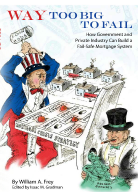
A Hardback Copy of Way Too Big to Fail and its Accompanying Note Card

This was the first time I had held a hardback copy of the book (of which we printed a limited run), and it was truly a glorious feeling.  There’s something about the weight of a hardback, the cracking sound that it makes when you first open it, and the vibrancy of the dust jacket that instills a sense of pride and a feeling that you’ve really created something lasting see image on right).


Soon, however, euphoria once again gave way to a recognition of the work that lay ahead, as we were tasked with putting together a massive number of mailings.  Anyone who has ever had a wedding or a Bar Mitzvah knows that writing note cards is one of the most tedious tasks in the universe, and writing note cards for a book is no different.  It took up the remainder of the day.

That night, in the split second between when my head hit the pillow and when I passed out from exhaustion, the thought occurred to me that our greatest challenge in getting our ideas to take root would be pervasive pessimism.  Wherever we went, people seemed to be overwhelmed by the problems facing our government and our economy, and with good reason.  The gridlock in Washington, the financial fraud perpetuated by some on Wall St., and the and negligence and general sloppiness that characterized 2004-2008 mortgage lending have been the hallmark of our country over the past half decade and have caused many to despair at the possibility of ever reaching a solution.  I decided that WTBTF was an important work, not only for the ideas it presented, but because it presented a message of hope and optimism – that there is a way to fix the housing market if financial leaders and regulators could simply work together to make our suggested reforms a reality.

I will continue to blog on The Subprime Shakeout over the next week about my experiences during my first book tour (first post in the series available here). On tap for Tuesday: meetings with a publicist, a reporter, and a big-time financial blogger; a speech to NYU Law students about alternative career paths; and more books and note cards to sign…

[All names used with permission – IMG]
Posted in Attorneys General, bailout, Dan Rather, due diligence firms, Government bailout, hedge funds, mortgage market, Neil Barofsky, putbacks, re-underwriting, Regulators, RMBS, securities, securities laws, securitization, TARP, The Subprime Shakeout, Timothy Geithner, too big to fail, Treasury, Wall St., Way Too Big to Fail, William Frey | Leave a comment

Release of “Way Too Big to Fail” Simply Opening Salvo in Efforts to Reform Mortgage Finance

It’s tempting when you have an enormous task before you to focus all of your attention on completing that task while blocking out any thoughts of what comes next.  For me, that enormous task has been the publication of a book with William (“Bill”) Frey to address the structural deficiencies in mortgage finance that brought about the subprime meltdown.  I must confess that with so much of my attention over the last several months dedicated to completing this book, I had little time to contemplate the even greater enormity of the task that lay ahead.  But with the publication by Greenwich Financial Press of Way Too Big to Fail: How Government and Private Industry Can Build a Fail-Safe Mortgage System (WTBTF) on October 31, 2011 (official website here), and its release on CreateSpace and Amazon last week, it’s suddenly sinking in how much work remains to be done for the words on those pages to have any impact.

Let me start by saying that I am extremely proud of the final product that is WTBTF.  While many books have attempted to identify the causes or villains behind the mortgage crisis, Way Too Big to Fail is the first that examines why government-enacted fixes have failed and explains in detail what must, should, and can be done to right the ship.  It thus takes a positive and proactive approach to the problems plaguing our economy, providing a welcome ray of hope in an industry in dire need of some good news.  As much as I enjoy covering the ongoing mortgage litigation playing out in our courts as we speak (more on that later), which has the capacity to decide the fate of huge financial institutions and perhaps the future of the U.S. mortgage market, I am even more excited about turning my attention to helping to ensure that the U.S. housing market survives and thrives going forward.

I believe that Way Too Big to Fail is an important first step down that path.  With the combination of Bill’s expertise in mortgage finance and my expertise—cultivated in no small part through my work on The Subprime Shakeout—in communicating complex ideas regarding mortgage finance and litigation in straightforward ways, I think the book succeeds at providing an accessible blueprint to the mortgage finance machine of the past, present, and future.  I can say without hesitation that it has been one of the most productive and enjoyable collaborations of my professional career.

But as I sit here at the San Francisco Airport, waiting to board the redeye to New York, I realize that this is only the beginning.  To sit back and allow myself to revel in this accomplishment would be to miss the larger and more important opportunity—the opportunity for these words to have an impact in the current mortgage finance landscape.  And though the book has now taken on a life of its own, with its own website, Facebook page, and Twitter account, I know that it will not succeed in influencing the conversation without a lot more effort on our part.

Thus, I am heading off to spend the next week with Bill in New York and Washington, D.C. to meet with a full slate of lawmakers, academics, financiers, reporters and others in the industry with the desire and/or the capacity to influence where our nation goes from here.  My hope is that we can all start from the common understanding that the federal government should not and cannot support the entire mortgage market—and that private investors must step in to fill the void—and begin discussing concrete proposals for attracting private capital.

Of course, as most people have now come to understand, private investors will not put any more money into private mortgage securities until the litigation raging over the mortgage backed securities (MBS) created from 2004 to 2007 is resolved.  As the FHFA stated in a press release in connection with its slew of recent lawsuits,

the long-term stability and resilience of the nation’s financial system depends on investors being able to trust that the securities sold in this country adhere to applicable laws. We cannot overlook compliance with such requirements during periods of economic difficulty as they form the foundation for our nation’s financial system.

In this regard, several major decisions are anticipated in the coming weeks.  The first is the decision in MBIA v. Countrywide on MBIA’s Motion for Partial Summary Judgment.  This decision, expected sometime this month, will determine the viability of Countrywide/BofA’s so-called “loss causation argument,” which maintains that an underwriting breach must actually cause a loan to go into default to constitute grounds for a putback.  All signs point to Countrywide/BofA losing this motion, as they find little support for their position in the contract language or the small amount of existing MBS putback precedent.  The “materially adverse” standard found in most pooling and servicing agreements mirrors closely the materiality standard used in the insurance context, and I see no reason why some proximate cause standard should be read into these contracts that would alter the ordinary understanding of a materially adverse impact on the value of a loan—i.e., something that increases the loan’s risk.

Moreover, with Judge Eileen Bransten having ruled against BofA in a recent motion to sever MBIA’s successor-in-interest claims from the rest of the case and try them separately with such claims from the other monoline cases, Bransten has now ruled against Countrywide/BofA in nearly every major decision thus far (see, e.g., her adverse rulings on discovery issues, statistical sampling, and the viability of MBIA’s successor-in-interest claims).  As Bransten has long appeared fed up with the heel-dragging and hide-the-ball tactics of Countrywide’s attorneys (entertaining transcript on motion to dismiss available here), there’s no reason to believe she’ll be any friendlier to their arguments this time around.

And the impact of a ruling against Countrywide/BofA on this motion will not be limited to this case alone; the opinion will almost certainly be cited in every ongoing putback case in the country.  Already, after Bransten’s most recent decision allowing MBIA to move forward with depositions on successor liability, we know that this case will be the country’s bellwether on the question of whether BofA engaged in a de facto merger with Countrywide.  The crowds that gathered inside the overflowing courtroom for the October 5 hearing on Partial Summary Judgment (see transcript part I and part II) illustrate just how closely the markets are watching this legal proceeding.

The other major decision that will be coming down the pike in the next few months is a ruling on Bank of New York’s appeal of Judge William Pauley’s order denying remand.  The significance of this ruling cannot be understated.  If this proposed settlement remains in federal court, Bank of America and/or Bank of New York will likely attempt to withdraw (as discussed by the astute Alison Frankel at Reuters) and the settlement will fall apart, creating even more chaos for the embattled lender.  Should the settlement go back to state court and breeze through to approval under the favorable standards of Article 77, you can expect every other major lender with subprime exposure to try the same tactic to resolve its outstanding putback liabilities.

I will certainly be watching these and other developments closely over the coming months.  But, I’m also going to be doing something a little different on The Subprime Shakeout.  I’m going to start making it a little more personal, by updating readers on the successes and failures of my efforts with Bill to push the needle on reforming the country’s mortgage finance system.

I’m going to start by blogging my East Coast trip this week, as we reach out to policymakers and industry leaders about the book and begin discussing our ideas for reform.  If you have an interest in seeing change in the way this country finances mortgages in the future, I invite you to participate by reading this blog and responding to me via the comments section or Twitter (@isaacgradman); interacting with WTBTF on Facebook and Twitter; and, of course, reading Way Too Big to Fail (you’ll notice this site’s first and only banner ad on the right sidebar, which links to the WTBTF’s CreateSpace page)and sharing your feedback and reviews with us, on Amazon, and with anyone else who you think could benefit from the ideas we present.  While I do not expect that our ideas will please everyone all of the time, I do think that the book initiates a conversation that has been a long time coming.

Way Too Big to Fail, authored by Bill Frey and edited by Isaac Gradman, was published by Greenwich Financial Press on October 31, 2011.  Please visit www.waytoobigtofail.com for information about the book, its author, and its editor; news and reviews on the book; and to view actual excerpts and illustrations.  The paperback edition is available on CreateSpace and Amazon; a limited edition hardback was also printed, some copies of which may be available through Amazon later this year.  If you feel so inclined, please like WTBTF on Facebook and follow @WTBTF on Twitter.

Posted in allocation of loss, appeals, Bank of New York, banks, BofA, bondholder actions, causes of the crisis, contract rights, Countrywide, discovery, FHFA, global settlement, investors, irresponsible lending, lawsuits, liabilities, litigation, lobbying, loss causation, MBIA, monoline actions, mortgage market, pooling agreements, private label MBS, putbacks, regulation, Regulators, remand, repurchase, RMBS, securitization, settlements, statistical sampling, successor liability, The Subprime Shakeout, Uncategorized, Way Too Big to Fail, William Frey | 1 Comment

BREAKING NEWS: Judge Determines BofA $8.5 bn Settlement Belongs in Federal Court

Though Bank of America (BofA) has taken its share of lumps over the past six months, this may be the one that leaves the biggest mark.  In an opinion issued today in the Southern District of New York (available here and hereinafter referred to as the “Order”), Judge William Pauley denied Bank of New York’s (BoNY) motion to send its Article 77 proceeding–seeking court approval for its decision to settle putback claims in 530 Countrywide trusts for $8.5 billion–back to state court.  This decision means that BoNY’s conduct will be evaluated under far less favorable standards for BoNY and BofA, and that disapproving bondholders may be permitted to “opt out” of the settlement.

If you will recall (and if you don’t, feel free to read my prior articles here and here for background), BoNY originally filed this action in New York state court in June of this year, seeking judicial approval under Article 77 for its decision to settle  potential repurchase claims or “putbacks” with respect to 530 Countrywide RMBS trusts.  Legal commentators hailed the use of Article 77 as “novel” and “creative” (it is usually reserved for garden variety family law trusts and other express trusts), citing the difficulty that investors would have in challenging the settlement under this special vehicle of New York law.

However, it soon became clear that numerous powerful parties were lining up in opposition to the settlement and were raising issues that would be difficult to ignore.  These included a challenge by the New York Attorney General, which accused BoNY of persistent illegality and fraud and raised the question of whether mortgages were properly transferred into Countrywide trusts at the outset.  At last count, 44 separate groups had filed petitions to intervene and challenge the settlement (or obtain more information) and one group had filed a petition to intervene in support of the accord.

In a surprise move, one such objector, Walnut Place, LLC, essentially hijacked the case–removing it to federal court and framing it as a “mass action” under the Class Action Fairness Act (CAFA).  This threatened to change the entire nature of the proceeding and prompted BoNY to file a motion to remand, in which it argued that Walnut Place’s efforts were unjustified and “frivolous” and urged Judge Pauley to send the case back to the friendlier confines of New York Supreme Court.

In hearings leading up to today’s Order, it appeared that Judge Pauley was skeptical about BoNY’s role and conduct in negotiating this settlement, and seemed inclined to keep the case.  In particular, His Honor seemed fixated on whether BoNY was subject to fiduciary duties derived from sources outside of the Pooling and Servicing Agreements (PSAs), which would weigh against finding that this case fell under the “securities exception” to CAFA.  This skepticism may have been exacerbated by revelations earlier this month that Gibbs & Bruns, the law firm representing the investors supporting the settlement, had urged its clients to withdraw from a parallel effort by Talcott Franklin’s Investor Clearinghouse to take more aggressive action against BoNY (you can read Alison Frankel’s astute coverage of these recent developments here).  But while the outcome of this motion may have been foreseeable, it was the tone of today’s opinion that I found most surprising.

In holding that CAFA provided the federal court with exclusive jurisdiction over this case, Judge Pauley found that Walnut Place had satisfied the elements for a mass action under CAFA, in that the case involved 1) monetary relief, 2) 100 or more persons, and 3) common questions of law and fact.  The Court did not seem to struggle with finding any of these elements or in dismissing BoNY’s claims that Walnut Place was not a proper party to remove the case.

The most robust discussion was reserved for the evaluation of whether the securities exception to CAFA applied, but even that thorny question was dealt with in relatively short order.  Repeatedly citing to Greenwich Financial v. Countrywide, 603 F.3d 23 (2d Cir. 2010), one of the earliest cases arising from the mortgage crisis (and discussed frequently on The Subprime Shakeout), Judge Pauley found that the “pivotal question” in reaching this determination was “whether a plaintiff’s claims arise under the terms of an instrument that creates or defines securities or plaintiff’s claims arise under an independent source of federal or state law.” (Order at 16)  His Honor noted that BoNY had conceded that New York trustees owe certain common law duties to trust beneficiaries that could not be waived, including the duty to avoid conflicts of interest.  In that regard, Pauley held that, “this duty–grounded in New York common law and not the terms of the PSAs–lies at the heart of the Article 77 Proceeding.” (Order at 17)

In disposing of BoNY’s counterarguments that the sources of its obligations were actually the governing PSAs, which had modified and superseded the Trustee’s common law duties, Judge Pauley noted wryly that, “PSAs are not talismans endowed with the power to ward off federal jurisdiction.  Because the Article 77 Proceeding necessarily involves New York common law, the securities exception does not bar removal.”  (Order at 19)  In other words, if the case involves common law questions not arising out of an agreement creating or defining a security, that’s enough for Pauley to find that the federal courts have jurisdiction.

Though Pauley appears unwavering and far from ambivalent in reaching this holding, the conclusion of his Order includes a remarkable appeal to the “core federal interests” implicated by this case, in what can only be described as a “belt and suspenders” approach to the determination of jurisdiction.  Rather than resting simply on the fact that the elements of CAFA were met and that the plaintiff did not carry its burden of proving any exception applied, Pauley recognizes the national implications of this case in an effort to bolster the decision to keep it in state court.  When reading the final paragraph of the Order, which I quote in full, consider whether this language will help Pauley’s opinion survive a potential appeal or suggest that he was swayed more by the case’s national prominence than an unemotional application of the relevant law:

The Settlement Agreement at issue here implicates core federal interests in the integrity of nationally chartered banks and the vitality of the national securities markets.  A controversy touching on these paramount federal interests should proceed in federal court.  And Congress enacted CAFA to provide a federal forum for such cases.  For the foregoing reasons, the Court denies BYNM’s motion to remand.  (Order at 21, citations omitted)

As much as I might agree with Pauley’s statements regarding the national implications of this case, I don’t believe issues such as the “integrity of nationally chartered banks and the vitality of the national securities markets” were actually before the Judge in this instance.  Instead, he was asked to rule on the narrow issue of whether remand of the Article 77 Proceeding was proper.  Because it’s tough to see how the vitality of the securities markets is directly implicated in adjudicating such a motion, I think this colorful flourish at the end of an otherwise well-reasoned opinion only weakens the credibility of the Order by suggesting that the Judge may have been influenced by the national attention this case has garnered.  Judge Pauley may have been well advised to end the discussion in his Order after the finding that the securities exception did not apply.  As Brad Pitt says in Moneyball in his role as Billy Beane, “when you get the answer you’re looking for, hang up.”

Implications

So what does this all mean to BoNY and, more importantly, BofA?  On one hand, the precise procedural implications are yet to be decided.  Pauley included a section in the Order entitled “Remaining Issues,” in which he states that “This Court recognizes the procedural difficulty inherent in continuing this action in federal court” and orders the parties to submit a joint case management report by October 31 and appear before him on November 3 for a status conference. (Order at 20)  On the other hand, I can’t help but speculate that Pauley will not be forced (as Judge Kapnick would have been in state court) to defer to the standards and constraints of Article 77 in adjudicating this case.  Having found that the federal court has exclusive jurisdiction under CAFA, Pauley will likely handle the case along the lines of other “mass actions.”  Though mass actions are not governed by the identical procedural standards as ordinary class actions, I would expect that Judge Pauley will borrow certain aspects.  This will likely include the application of an “entire fairness” standard to evaluate the settlement rather than the more deferential “abuse of discretion” standard.  It will likely also mean that the Court will either require that a majority of potential claimants (i.e. bondholders) approve of the settlement, or allow disapproving bondholders to “opt out.”  This will completely undermine BofA’s strategy of settling uncertainty in the markets and resolving its legacy Countrywide liability in a rapid and favorable manner.  Now, the Court will likely be able to examine the inner workings of how this deal came about, learn that most bondholders were not consulted or notified, realize that BoNY’s experts based their loss estimates on inapplicable information provided to them by BofA, and evaluate whether BoNY was acting under a conflict of interest when agreeing to this settlement.  Disapproving bondholders may be able to extract themselves from this settlement, preserve their claims, and file separate lawsuits against Countrywide and BofA.  None of this is good for BofA.

Thus, the biggest question remaining in my mind is, can BoNY voluntarily withdraw this settlement without invoking the ire of Judge Pauley and startling the markets, or now that they’ve proceeded down this path, are they stuck with the monster they’ve created?  Only one thing’s for sure: BofA’s black eye will not be healing anytime soon.

Posted in Bank of New York, banks, BofA, bondholder actions, class actions, conflicts of interest, contract rights, Countrywide, damages, fiduciary duties, global settlement, Grais and Ellsworth, Greenwich Financial Services, investors, lawsuits, litigation, loss estimates, MBS, pooling agreements, private label MBS, putbacks, remand, removability, repurchase, RMBS, securities, securities laws, securitization, settlements, The Subprime Shakeout, Trustees, Uncategorized, William Frey | 4 Comments

Originator Business Models Led Inevitably to Housing Crash

by Steve Ruterman, guest blogger

It has been four years since the onset of the epic economic and capital markets fiasco known as the housing crash, and this crisis is far from over.  Because the housing and mortgage finance industries are so important to the nation’s economy, we simply can’t afford to wait until we reach the endgame before we reach an understanding of what happened and why.

There are a lot of explanations out there already.  For example, Michael Lewis in The Big Short: Inside the Doomsday Machine says the crisis took place because the big banks ceased operating as private partnerships taking prudent risks with the partners’ money.  Instead, they became public companies, and began taking undue risks with public shareholders’ money.  Maybe this is so, but there were plenty of bubbles, crashes, panics and insolvent banks in the country’s history prior to the public ownership of banks.

Adam Levitin and Susan Wachter, in “Explaining the Housing Bubble,” argue that the market bubble and subsequent crash were due to an oversupply of housing finance, which was caused in turn by the explosive growth of the non-agency securitization market.  The oversupply occurred because the complexity and heterogeneity of private label mortgage securities permitted bankers to game investors, who were unable to price their risks correctly.  The authors identify the standardization of mortgages and securitizations as the means of avoiding future fiascos.  It would be interesting to see how the authors explain the current problems associated with GSE efforts to mitigate risks via standardized mortgages and securitizations, which they’ve had for over 30 years since Fannie issued its first pass-through in 1981.

Though neither of these explanations seems entirely satisfying on its own, there is no reason to expect the various explanations to be mutually exclusive.  Instead, each adds important detail to the complex phenomenon that was the housing crash.  No doubt, the crash had many fathers.

It is possible, however, that the causes of the crash are relatively simple to identify and understand, even though future remedies may not be.  One of the simplest explanations can be found in the business models of the big mortgage lenders.  Let’s take Countrywide to be our exemplar, and focus in on the 2005–2007 time period.  Remember that Countrywide concentrated on the refinance (“refi’) segment of the market.

Courtesy of Calculated Risk

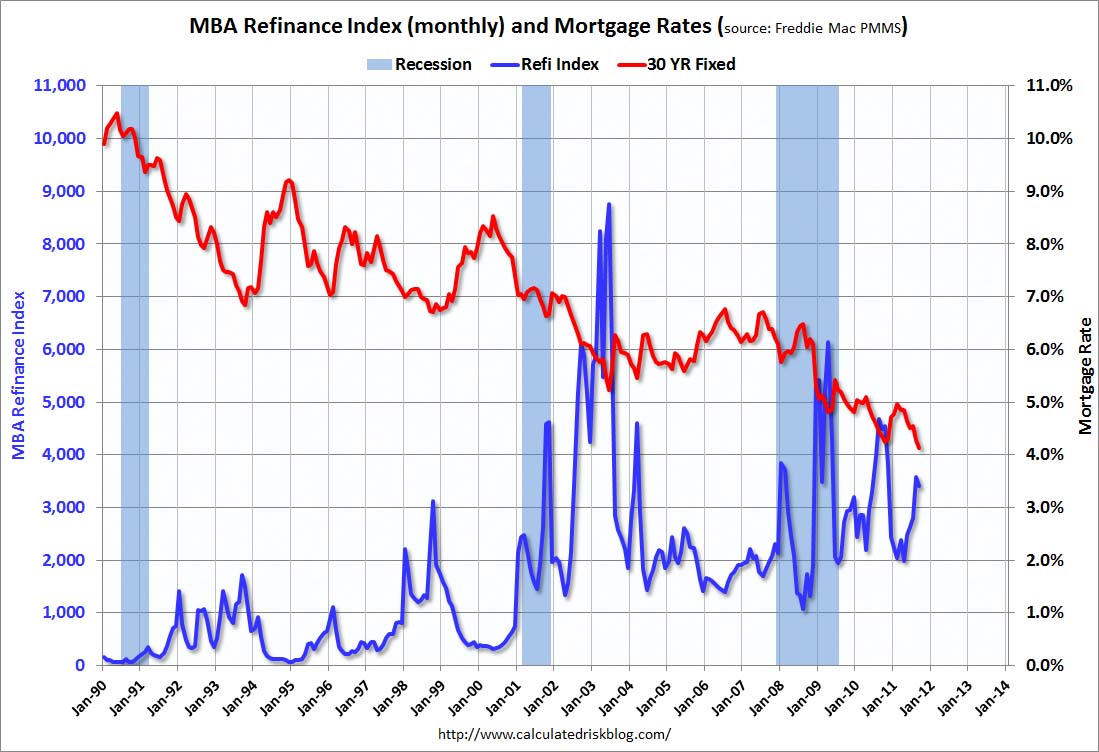
MBA Mortgage Refi Index and Mortgage Rates - Sept. 2011

Taking note of the dramatic slowdown in refis after 2003 (see chart at right courtesy of Calculated Risk), Countrywide officers were quite vocal in airing their concerns about maintaining and growing their share of the stagnant mortgage market.  How was Countrywide, a publicly traded mortgage colossus with over a trillion dollars in existing mortgages, going to grow its earnings per share when the market was not growing?  Given its size and scale, the only way to do it was to market additional loans to its existing customers or to relax its credit underwriting standards for each of its loan product categories, so that it could lend to borrowers who would not have qualified for credit in years past.  Apparently, Countrywide did both.

The following is an excerpt from the complaint AIG filed against Countrywide, et al., on August 8, 2011:

In a conference call with analysts in 2003, [CEO Angelo] Mozilo made Countrywide’s market share objectives explicit, stating that his goal for Countrywide Financial was to “dominate” the mortgage market and “to get our overall market share to the ultimate 30% by 2006, 2007.” At the same time, Countrywide made public assurances that its growth in originations would not compromise its strict underwriting standards. Indeed, Mozilo publicly stated that Countrywide would target the safest borrowers in this market in order to maintain its commitment to quality.


To increase its market share, Countrywide instituted an aggressive “matching” program that effectively ceded its “theoretical” underwriting standards to the market and resulted in a proverbial race to the bottom. Under Countrywide’s “matching” policy, Countrywide would match any product that a competitor was willing to offer. A former finance executive at Countrywide explained: “To the extent more than 5 percent of the [mortgage] market was originating a particular product, any new alternative mortgage product, then Countrywide would originate it …


[Author’s Note:  Allegations made by plaintiff’s counsel in a complaint are what they are.]

The point from this is that it’s not necessary to construct complex explanations of the mortgage market’s collapse.  It is sufficient to understand the relatively simple business models of the boom’s beneficiaries.

However, for a comprehensive analysis of business models and the many other factors which led to the collapse of the mortgage market, I would recommend Way Too Big To Fail: How Government and Private Industry Can Build a Fail-Safe Mortgage System from Greenwich Financial Press.  The book, written by William A. Frey and edited by The Subprime Shakeout’s Isaac Gradman, is now available on CreateSpace and Amazon.  Therein, Frey draws on 30 years of experience in structured finance to detail both the causes of the crisis and the reforms and steps to be taken to bring private investment back to the housing market.

Frey appears to share my belief that we can’t recover from this crisis until we fully understand its causes.  And at the end of the day, the main culprit he identifies is similar to the one I detail above–misaligned incentives for those creating mortgage securities.  I won’t give too much away, but having read an advance copy of this work, I can say that Frey’s analysis is fundamentally correct and that his recommendations are realistic and necessary.  I would highly encourage the read for anyone seeking to understand the flawed business models that got us into this mess and, more importantly, what we can do to dig ourselves out.


Steve Ruterman is an independent consultant to institutions and institutional investors with significant RMBS exposures and a fan of The Subprime Shakeout.  He recently retired after a 14 year career with MBIA Insurance Corporation, during which he terminated over 20 mortgage loan servicers.  Mr. Ruterman welcomes your comments, and can be reached by email at Steve.Ruterman@yahoo.com.

[Updated on 11/4 to reflect that Way Too Big to Fail has been released and is now available – IMG]

Posted in AIG, banks, broader credit crisis, causes of the crisis, Complaints, Countrywide, Fannie Mae, Freddie Mac, guest posts, incentives, interest rates, irresponsible lending, lawsuits, lenders, lending guidelines, MBIA, MBS, mortgage market, private label MBS, research, RMBS, securitization, The Subprime Shakeout, Uncategorized, Way Too Big to Fail, William Frey | Tagged , , , , , , | Leave a comment