The Government Giveth and It Taketh Away: The Significance of the Game Changing FHFA Lawsuits

It is no stretch to say that Friday, September 2 was the most significant day for mortgage crisis litigation since the onset of the crisis in 2007.  That Friday, the Federal Housing Finance Agency (FHFA), as conservator for Fannie Mae and Freddie Mac, sued almost all of the world’s largest banks in 17 separate lawsuits, covering mortgage backed securities with original principal balances of roughly $200 billion.  Unless you’ve been hiking in the Andes over the last two weeks, you have probably heard about these suits in the mainstream media.  But here at the Subprime Shakeout, I like to dig a bit deeper.  The following is my take on the most interesting aspects of these voluminous complaints (all available here) from a mortgage litigation perspective.

Throwing the Book at U.S. Banks

The first thing that jumps out to me is the tenacity and aggressiveness with which FHFA presents its cases.  In my last post (Number 1 development), I noted that FHFA had just sued UBS over $4.5 billion in MBS.  While I noted that this signaled a shift in Washington’s “too-big-to-fail” attitude towards banks, my biggest question was whether the agency would show the same tenacity in going after major U.S. banks.  Well, it’s safe to say the agency has shown the same tenacity and then some.

FHFA has refrained from sugar coating the banks’ alleged conduct as mere inadvertence, negligence, or recklessness, as many plaintiffs have done thus far.  Instead, it has come right out and accused certain banks of out-and-out fraud.  In particular, FHFA has levied fraud claims against Countrywide (and BofA as successor-in-interest), Deutsche Bank, J.P. Morgan (including EMC, WaMu and Long Beach), Goldman Sachs, Merrill Lynch (including First Franklin as sponsor), and Morgan Stanley (including Credit Suisse as co-lead underwriter).  Besides showing that FHFA means business, these claims demonstrate that the agency has carefully reviewed the evidence before it and only wielded the sword of fraud against those banks that it felt actually were aware of their misrepresentations.

Further, FHFA has essentially used every bit of evidence at its disposal to paint an exhaustive picture of reckless lending and misleading conduct by the banks.  To support its claims, FHFA has drawn from such diverse sources as its own loan reviews, investigations by the SEC, congressional testimony, and the evidence presented in other lawsuits (including the bond insurer suits that were also brought by Quinn Emanuel).  Finally, where appropriate, FHFA has included successor-in-interest claims against banks such as Bank of America (as successor to Countrywide but, interestingly, not to Merrill Lynch) and J.P. Morgan (as successor to Bear Stearns and WaMu), which acquired potential liability based on its acquisition of other lenders or issuers and which have tried and may in the future try to avoid accepting those liabilities.    In short, FHFA has thrown the book at many of the nation’s largest banks.

FHFA has also taken the virtually unprecedented step of issuing a second press release after the filing of its lawsuits, in which it responds to the “media coverage” the suits have garnered.  In particular, FHFA seeks to dispel the notion that the sophistication of the investor has any bearing on the outcome of securities law claims – something that spokespersons for defendant banks have frequently argued in public statements about MBS lawsuits.  I tend to agree that this factor is not something that courts should or will take into account under the express language of the securities laws.
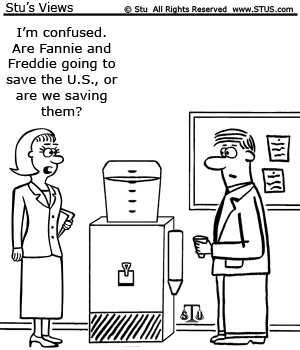
The agency’s press release also responds to suggestions that these suits will destabilize banks and disrupt economic recovery.  To this, FHFA responds, “the long-term stability and resilience of the nation’s financial system depends on investors being able to trust that the securities sold in this country adhere to applicable laws. We cannot overlook compliance with such requirements during periods of economic difficulty as they form the foundation for our nation’s financial system.”  Amen.

This response to the destabilization argument mirrors statements made by Rep. Brad Miller (D-N.C.), both in a letter urging these suits before they were filed and in a conference call praising the suits after their filing.  In particular, Miller has said that failing to pursue these claims would be “tantamount to another bailout” and akin to an “indirect subsidy” to the banking industry.  I agree with these statements – of paramount importance in restarting the U.S. housing market is restoring investor confidence, and this means respecting contract rights and the rule of law.   If investors are stuck with a bill for which they did not bargain, they will be reluctant to invest in U.S. housing securities in the future, increasing the costs of homeownership for prospective homeowners and/or taxpayers.

You can find my recent analysis of Rep. Miller’s initial letter to FHFA here under Challenge No. 3.  The letter, which was sent in response to the proposed BofA/BoNY settlement of Countrywide put-back claims, appears to have had some influence.

Are Securities Claims the New Put-Backs?

The second thing that jumps out to me about these suits is that FHFA has entirely eschewed put-backs, or contractual claims, in favor of securities law, blue sky law, and tort claims.  This continues a trend that began with the FHLB lawsuits and continued through the recent filing by AIG of its $10 billion lawsuit against BofA/Countrywide of plaintiffs focusing on securities law claims when available.  Why are plaintiffs such as FHFA increasingly turning to securities law claims when put-backs would seem to benefit from more concrete evidence of liability?

One reason may be the procedural hurdles that investors face when pursuing rep and warranty put-backs or repurchases.  In general, they must have 25% of the voting rights for each deal on which they want to take action.  If they don’t have those rights on their own, they must band together with other bondholders to reach critical mass.  They must then petition the Trustee to take action.  If the Trustee refuses to help, the investor may then present repurchase demands on individual loans to the originator or issuer, but must provide that party with sufficient time to cure the defect or repurchase each loan before taking action.  Only if the investor overcomes these steps and the breaching party fails to cure or repurchase will the investor finally have standing to sue.

All of those steps notwithstanding, I have long argued that put-back claims are strong and valuable because once you overcome the initial procedural hurdles, it is a fairly straightforward task to prove whether an individual loan met or breached the proper underwriting guidelines and representations.  Recent statistical sampling rulings have also provided investors with a shortcut to establishing liability – instead of having to go loan-by-loan to prove that each challenged loan breached reps and warranties, investors may now use a statistically significant sample to establish the breach rate in an entire pool.

So, what led FHFA to abandon the put-back route in favor of filing securities law claims?  For one, the agency may not have 25% of the voting rights in all or even a majority of the deals in which it holds an interest.  And due to the unique status of the agency as conservator and the complex politics surrounding these lawsuits, it may not have wanted to band together with private investors to pursue its claims.

Another reason may be that the FHFA has had trouble obtaining loan files, as has been the case for many investors.  These files are usually necessary before even starting down the procedural path outlined above, and servicers have thus far been reluctant to turn these files over to investors.  But this is even less likely to be the limiting factor for FHFA.  With subpoena power that extends above and beyond that of the ordinary investor, the government agency may go directly to the servicers and demand these critical documents.  This they’ve already done, having sent 64 subpoenas to various market participants over a year ago.  While it’s not clear how much cooperation FHFA has received in this regard, the numerous references in its complaints to loan level reviews suggest that the agency has obtained a large number of loan files.  In fact, FHFA has stated that these lawsuits were the product of the subpoenas, so they must have uncovered a fair amount of valuable information.

Thus, the most likely reason for this shift in strategy is the advantage offered by the federal securities laws in terms of the available remedies.  With the put-back remedy, monetary damages are not available.  Instead, most Pooling and Servicing Agreements (PSAs) stipulate that the sole remedy for an incurable breach of reps and warranties is the repurchase or substitution of that defective loan.  Thus, any money shelled out by offending banks would flow into the Trust waterfall, to be divided amongst the bondholders based on seniority, rather than directly into the coffers of FHFA (and taxpayers).  Further, a plaintiff can only receive this remedy on the portion of loans it proves to be defective.  Thus, it cannot recover its losses on defaulted loans for which no defect can be shown.

In contrast, the securities law remedy provides the opportunity for a much broader recovery – and one that goes exclusively to the plaintiff (thus removing any potential freerider problems).  Should FHFA be able to prove that there was a material misrepresentation in a particular oral statement, offering document, or registration statement issued in connection with a Trust, it may be able to recover all of its losses on securities from that Trust.  Since a misrepresentation as to one Trust was likely repeated as to all of an issuers’ MBS offerings, that one misrepresentation can entitle FHFA to recover all of its losses on all certificates issued by that particular issuer.

The defendant may, however, reduce those damages by the amount of any loss that it can prove was caused by some factor other than its misrepresentation, but the burden of proof for this loss causation defense is on the defendant.  It is much more difficult for the defendant to prove that a loss was caused by some factor apart from its misrepresentation than to argue that the plaintiff hasn’t adequately proved causation, as it can with most tort claims.

Finally, any recovery is paid directly to the bondholder and not into the credit waterfall, meaning that it is not shared with other investors and not impacted by the class of certificate held by that bondholder.  This aspect alone makes these claims far more attractive for the party funding the litigation.  Though FHFA has not said exactly how much of the $200 billion in original principal balance of these notes it is seeking in its suits, one broker-dealer’s analysis has reached a best case scenario for FHFA of $60 billion flowing directly into its pockets.

There are other reasons, of course, that FHFA may have chosen this strategy.  Though the remedy appears to be the most important factor, securities law claims are also attractive because they may not require the plaintiff to present an in-depth review of loan-level information.  Such evidence would certainly bolster FHFA’s claims of misrepresentations with respect to loan-level representations in the offering materials (for example, as to LTV, owner occupancy or underwriting guidelines), but other claims may not require such proof.  For example, FHFA may be able to make out its claim that the ratings provided in the prospectus were misrepresented simply by showing that the issuer provided rating agencies with false data or did not provide rating agencies with its due diligence reports showing problems with the loans.  One state law judge has already bought this argument in an early securities law suit by the FHLB of Pittsburgh.  Being able to make out these claims without loan-level data reduces the plaintiff’s burden significantly.

Finally, keep in mind that simply because FHFA did not allege put-back claims does not foreclose it from doing so down the road.  Much as Ambac amended its complaint to include fraud claims against JP Morgan and EMC, FHFA could amend its claims later to include causes of action for contractual breach.  FHFA’s initial complaints were apparently filed at this time to ensure that they fell within the shorter statute of limitations for securities law and tort claims.  Contractual claims tend to have a longer statute of limitations and can be brought down the road without fear of them being time-barred (see interesting Subprime Shakeout guest post on statute of limitations concerns.

Predictions

Since everyone is eager to hear how all this will play out, I will leave you with a few predictions.  First, as I’ve predicted in the past, the involvement of the U.S. Government in mortgage litigation will certainly embolden other private litigants to file suit, both by providing political cover and by providing plaintiffs with a roadmap to recovery.  It also may spark shareholder suits based on the drop in stock prices suffered by many of these banks after statements in the media downplaying their mortgage exposure.

Second, as to these particular suits, many of the defendants likely will seek to escape the harsh glare of the litigation spotlight by settling quickly, especially if they have relatively little at stake (the one exception may be GE, which has stated that it will vigorously oppose the suit, though this may be little more than posturing).  The FHFA, in turn, is likely also eager to get some of these suits settled quickly, both so that it can show that the suits have merit with benchmark settlements and also so that it does not have to fight legal battles on 18 fronts simultaneously.  It will likely be willing to offer defendants a substantial discount against potential damages if they come to the table in short order.

Meanwhile, the banks with larger liability and a more precarious capital situation will be forced to fight these suits and hope to win some early battles to reduce the cost of settlement.  Due to the plaintiff-friendly nature of these claims, I doubt many will succeed in winning motions to dismiss that dispose entirely of any case, but they may obtain favorable evidentiary rulings or dismissals on successor-in-interest claims.  Still, they may not be able to settle quickly because the price tag, even with a substantial discount, will be too high.

On the other hand, trial on these cases would be a publicity nightmare for the big banks, not to mention putting them at risk a massive financial wallop from the jury (fraud claims carry with them the potential for punitive damages).  Thus, these cases will likely end up settling at some point down the road.  Whether that’s one year or four years from now is hard to say, but from what I’ve seen in mortgage litigation, I’d err on the side of assuming a longer time horizon for the largest banks with the most at stake.

Posted in acquisitions, Ambac, bailout, banks, Bear Stearns, BofA, bondholder actions, Complaints, contract rights, Countrywide, damages, Deutsche Bank, emc, Fannie Mae, Federal Home Loan Banks, FHFA, Freddie Mac, freeriders, Goldman Sachs, Government bailout, investors, irresponsible lending, JPMorgan, jury trials, lawsuits, lending guidelines, liabilities, litigation, litigation costs, loan files, loss causation, loss estimates, LTV, MBS, media coverage, Merrill Lynch, misrespresentation, monoline actions, mortgage fraud, motions to dismiss, negligence and recklessness, private label MBS, procedural hurdles, putbacks, quinn emanuel, ratings agencies, rep and warranty, repurchase, RMBS, securities, securities laws, securitization, shareholder lawsuits, sole remedy, sophistication, stability, standing, statistical sampling, statutes of limitations, subpoenas, successor liability, too big to fail, Trustees, underwriting practices, Wall St., WaMu | 6 Comments

RMBS Legal Roundup: The Top Five Developments You Might Have Missed While Obsessing Over the BoNY/BofA Settlement

With interesting developments occurring almost daily in the proposed Bofa/Countrywide settlement with Bank of New York, it has been hard to focus on anything else.  Indeed, since the last time I posted on the settlement (discussing New York AG Eric Schneiderman’s momentous challenge), AIG and the Delaware Attorney General have filed petitions to intervene and BoNY and the 22 investor group have filed oppositions to the New York AG’s petition that matched the prosecutor in ferocity.

But that’s not what I want to talk about today.  Instead, I’d like to take a few minutes to cover some of the most important developments in RMBS litigation aside from the BofA settlement and Death Watch (courtesy of Naked Capitalism).  There are many from which to choose, but these five were, to me, the most interesting non-Countrywide RMBS developments.

Number 5 – JP Mogan Settles Charges over Magnetar CDO

On June 21, the SEC announced that it had entered into a $154 million settlement with JP Morgan over civil fraud charges associated with the Squared CDO, which the bank set up for a hedge fund named Magnetar.  The SEC asserted that JPM misled investors regarding the synthetic securities and stuck these unsuspecting investors with some of the world’s ugliest mortgages just before the market tanked. Helpful infographic here.

Maybe it has something to do with the fact that I had just watched X-Men: First Class, but whenever I heard discussion about Magnetar, I couldn’t help but picture Magneto, the mutant arch-villain that could manipulate magnetic fields with his mind.  In fact, there were a lot of parallels.  Just like Magneto, hedge fund Magnetar weakened the architecture of Squared to profit from the structure’s collapse.  It succeeded in shorting subprime mortgages by constructing Squared CDO with the worst mortgage securities it could find.  We’ll call this “Magnetaring” a deal.

Just as Magneto was allowed to walk by authorities once he lost his powers, Magnetar has also escaped legal prosecution (as did hedge fund Paulson & Co., which played a similar role in selecting the mortgage derivatives to stuff into Goldman Sachs’ Abacus deals).  It’s not technically illegal if there’s a sucker on the other side of the deal.

Instead, the SEC decided to go after JP Morgan for failing to disclose to its investors that the collateral for the CDO had been adversely selected by a party that would profit should the CDO fail.   All I know is, if I were a CDO investor, I would certainly consider it material if a prospective deal had been Magnetared.

Though the SEC has not done much to address the glaring irregularities in the creation of MBS, it has at least taken a stab at addressing the underhanded behavior by investment banks surrounding the black boxes that were CDOs (often comprised of the leftover pieces of mortgage backed securitizations the bank couldn’t sell directly).  Yet, I wonder whether this is really the best use of the SEC’s time and taxpayer dollars.  Though the amount of these settlements sounds large to the average layperson, $154 million is a drop in the bucket to JP Morgan (JPM’s stock actually rose 18 cents to $41.09 on the news) and is less than one-third the size of the settlement Goldman Sachs paid as part of the Abacus deal.  And while commentators speculate that the SEC will bring more such actions against other banks, my guess is that they won’t go after Goldman or JP Morgan for any other CDO transactions, including the Hudson-Mezzanine deal that garnered so much attention during the Levin Commission’s investigations.

So, while the SEC touts the fact in its press release that “harmed investors will receive all of their money back,” and provides a colorful infographic to illustrate how Squared CDO was “a bad deal for investors,” it is doing nothing to recover the monies lost by investors in the scores of other similar deals orchestrated by these banks.  As with so many other problems arising out of the mortgage crisis, we’ll have to rely on private litigants to take remedial steps on this front.  At least the SEC settlement might provide these plaintiffs with enough encouragement to come forward, sparking class action lawsuits like those that followed Goldman’s Abacus deal.

Number 4 – HUD Inspector General Accuses BofA of Obstructing Investigation

On June 13, the Huffington Post reported that Bank of America had “significantly hindered” a federal investigation into the firm’s foreclosure practices, according to William W. Nixon, the federal fraud examiner and assistant regional inspector general for HUD’s inspector general office.  Nixon accused BofA of withholding key documents and data and preventing the agency from interviewing key employees with knowledge of BofA’s foreclosure practices.  Nixon also stated that the bank prevented his team from conducting a walkthrough of the bank’s documents unit and failed to comply with subpoenas issued by Nixon’s team.  Though Nixon’s investigation has been completed, news of these allegations just recently became public when documents created by Nixon and his team were filed in a lawsuit brought by the State of Arizona against the bank.

According to Nixon, BofA’s intransigence forced him to ask the DOJ to issue civil investigative demands to compel testimony, a much less effective means of carrying out his investigation.  Ultimately, Nixon’s final report found that the nation’s five largest servicers defrauded taxpayers and violated the FCA by submitting false claims for FHA insurance coverage to the government.  These investigation results have been turned over to the DOJ for possible prosecution. 

Aside from putting the banks at risk of criminal prosecution, the government’s recent scrutiny of FHA claims submitted by the big banks could create significant legal exposure.  A report issued on June 13, 2011 by Bernstein Research estimates that, since inception of BofA’s relationship with the FHA, BofA originated $800 billion worth of FHA loans.  The report notes that, “[e]arlier in the year, our discussions with the company left us with the impression that FHA loans were not a material risk for BofA. However, during our recent Strategic Decisions Conference, CEO Brian Moynihan said that the FHA loans and BofA’s servicing activities are ‘a risk that [the company] continues to monitor.'”  Though the report does not provide a specific estimate of losses related to false claims for FHA insurance – including stemming from lawsuits such as the one the DOJ has already filed against Deutsche Bank for this type of conduct – it does estimate that BofA will face another $27 billion of housing-related losses between 2Q11-2013.  That’s on top of the $46 billion BofA has already lost.

With the Treasury having cut off HAMP payments to several servicers, including BofA, and the AGs still hot on extracting a $20+ billion settlement from servicers, it’s not surprising that many banks want out of the servicing business entirely.  This will open the doors for independent servicers to fill the void – ideally those without prior origination activities or section lien holdings.

Number 3 – Class Actions Alive and Well

Much has been made about the fact that class actions on behalf of RMBS investors have not fared well in courts around the nation.  This article discusses how this trend resulted in 85% of the RMBS originally included in the suits being dismissed.  This guest post by Josh Silverman in The Subprime Shakeout discusses some of the consequences of that trend and the specter of additional RMBS litigation.

Earlier this week, Judge Jed Rakoff in the Southern District of New York issued the explanation for his June 16 opinion granting class certification in the case of Public Employees’ Retirement System of Mississippi, et al. v. Merrill Lynch & Co., et al. (08-CV-10841), and sent a strong signal to banks and investors that the class action vehicle was alive and well.  Whereas many earlier opinions on RMBS class cert had limited the scope of the class to those investors who bought the same securities as the named plaintiffs (that is, they had to own securities in the same tranche as the named plaintiffs, not just securities from the same offering), Judge Rakoff certified a class that included all investors that purchased any Merrill Lynch-issued mortgage backed securities from 18 separate offerings between 2006 and 2007.

Rakoff’s opinion may be found here.  Therein, Rakoff found that Plaintiffs had “satisfied all of the requirements for class certification under Rules 23(a) and 23(b)(3). As courts have
repeatedly found, suits alleging violations of the securities laws, particularly those brought pursuant to Sections 11 and 12(a)(2), are especially amenable to class action resolution.” (Rakoff Opinion at 3)  This is a far cry from the earlier decision of Judge Harold Baer, Jr. in the Southern District of New York (yes, the same court on which Rakoff sits), who found that investors varied in sophistication to such an extent that individual questions predominated. I think “risk?” is a question that most investors know how to ask.

Likewise, Rakoff held that the action before him depended primarily on “establishing that certain statements and omissions common to all the offerings were material misrepresentations: a classic basis for a class action.” (Id. at 3-4)  Because the class action approach would result in an “enormous savings in judicial resources,” Rakoff affirmed his June 15, 2011 Order granting class cert in all respects. (Id. at 4)

Rakoff’s opinion comes on the heels of another momentous decision, handed down last week by Judge Paul Crotty, also from the Southern District of New York.  In the 15-pager, Crotty approved class certification for a group of 103 RMBS investors who had purchased Credit Suisse securities.  In doing so, he made clear that he wasn’t buying the argument that the disparity of sophistication among RMBS investors destroyed the commonality of the class.  Colorfully, Crotty noted that, “Defendants’ view is apparently that, in order for a class to be certified, it must be like Baby Bear’s porridge in the story of Goldilocks: just right. This suggestion is untenable.” (Crotty Opinion at 11 n.1)

These two judicial opinions confirm what many of us following RMBS legal developments have known for some time: underwriting deficiencies and misleading prospectuses were not isolated occurrences – they were par for the course.  By 2005, the abandonment of sound underwriting practices and the packaging of defective loans without proper disclosure had become part of the industry standard on Wall St., and this conduct harmed investors at every level of seniority and sophistication.  Permitting class actions allows investors to overcome many of the procedural hurdles that banks have been hiding behind in recent years while discounting their potential put-back liabilities on their earnings statements.  Namely, if a few investors can bring class actions on behalf of all other affected investors, they can overcome the difficulties that bondholders have had in finding one another and banding together.  They all ate the same porridge, and it had been Magnetared in the microwave too long.  Larger global settlements now become more likely.  Already, a reputable law firm has re-filed a massive class action against several underwriters that purports to cover $350 billion worth of RMBS.  And that’s far too hot for even the biggest banks.

Number 2 – NCUA Opens Fire On Behalf of Failed Credit Unions

This agency is racking up the lawyer points.  I thought it was pretty bold when the National Credit Union Administration (NCUA) threatened to sue some of Wall Street’s biggest banks over MBS losses.  But then, the NCUA actually backs it up with four separate lawsuits, seeking a total of $2 billion in damages?  It’s safe to say somebody over there is fired up.

In the first batch of suits, filed on June 20 in Kansas City federal court, the NCUA sued J.P. Morgan Chase & Co. and Royal Bank of Scotland (RBS) for $278 million and $565 million, respectively, in damages from purchases of RMBS by the five failed corporate credit unions.  The suits allege that the banks “systematically disregarded the underwriting guidelines stated in the offering documents,” resulting in securities that “were destined from inception to perform poorly.” According to the suits, at the time of filing, nearly half of the mortgage loans underlying the securities were delinquent, in bankruptcy or tied up in foreclosure.  This was exactly what I used to see all day when reviewing subprime due diligence reports, and trust me, you get pissed.

On July 18, the NCUA struck again, firing off another lawsuit against RBS, this time in Los Angeles federal court with a demand for $629 million in damages based on violations of federal and state securities laws.  This lawsuit was filed on behalf of WesCorp, which failed and was taken over by the NCUA on March 20, 2009. In a press release issued by the NCUA contemporaneously with this filing, the regulator stated that RBS’s misrepresentations “caused WesCorp to believe the risk of loss associated with the investment was minimal, when in fact the risk was substantial.”  A subtle, but important difference.

Most recently, on August 9, the NCUA sued Wall St. paragon Goldman Sachs in federal court in Los Angeles, seeking over $491 million in damages.   This lawsuit likewise alleges misrepresentations relating to 22 separate securities offerings, stating that, “a material percentage of the borrowers whose mortgages comprised the RMBS were all but certain to become delinquent or default shortly after origination. As a result the RMBS were destined from inception to perform poorly.”  Aka, Magnetared.

So, who is behind this aggressive federal action? Maybe it’s NCUA Chairman Debbie Matz, who issued a statement saying that, “NCUA continues to carry out our responsibility to do everything reasonable in our power to seek maximum recoveries.  Those who caused the problems in the wholesale credit unions should pay for the losses now being paid by retail credit unions.” Matz is just saying what every institutional investor should be saying right now – “these deals are totally Magnetared, and I want my money back.”

By the way, the NCUA has stated that it anticipates filing a total of 5 to 10 lawsuits in this space before all is said and done. Since, of the banks mentioned in its initial threats, only Merrill Lynch and Citigroup have not yet been sued, I’d bet dollars to donuts that these guys are also racking up the lawyer points.

Number 1 – FHFA Subpoenas Bear Fruit

Over a year ago, I wrote an article about how the Federal Housing Finance Agency (FHFA), as conservator for Freddie and Fannie, had issued 64 subpoenas to various participants in mortgage securitization, seeking underwriting documents for the RMBS the GSEs had purchased.  Since then, I have received many inquiries regarding the status of those subpoenas.  Until recently, I had little to offer, as it was all quiet over at FHFA.

Then, on July 27, FHFA finally pounced, filing a lawsuit against various UBS entities and executives in the Southern District of New York to recover losses on $4.5 billion worth of private label mortgage backed securities. The 102-page Complaint alleges violations of the federal securities laws based on misrepresentations regarding borrower creditworthiness and underwriting standards, yadda-yadda.

In a press release, the federal agency stated that it expects additional lawsuits to follow.  “FHFA is taking this action consistent with our responsibilities as conservator of each Enterprise,” said FHFA Acting Director Edward J. DeMarco. “From the issuance of 64 subpoenas last year to the filing of this lawsuit and further actions to come, we continue to seek redress for the losses suffered by the Enterprises.”

The big question that remains for me is whether the FHFA will show the same aggression toward U.S. banks that it has toward the Swiss banking giant.  For political reasons (e.g. “too big to fail” protectionism), they may not, which would mean leaving a lot of money on the table for the GSEs (and thus taxpayers).  Remember that FHFA inherited over $250 billion in private label MBS garbage when it took over the failed institutions as conservator.

While the claims asserted in the cases filed by the FHFA and NCUA may not be novel, they are significant because of their size and the fact that they are being driven by federal regulators.  This hints at a subtle shift in the “too big to fail” political climate since the outset of the crisis, and banks are no longer being viewed or treated as off-limits.  Instead, investors of all sorts (even Treasury-owned AIG, which recently sued BofA for over $10 billion in damages) are looking to recover their losses however they can, and in particular from the banks that make for ready villains.

As the last dominoes fall for many hulking financial institutions, they will be forced to admit that their “past experience” with private label put-backs no longer applies, and they will continue to blow through each successive round of loss reserves.   Indeed, the size of this country’s subprime shakeout seems only to expand as investors – and courts – come to fully understand the true villainy that was involved in putting mortgage securities together.

Posted in AIG, Attorneys General, Bank of New York, banks, BofA, bondholder actions, CDOs, class actions, Complaints, contract rights, costs of the crisis, Credit Unions, damages, Deutsche Bank, Fannie Mae, FHFA, Freddie Mac, global settlement, Goldman Sachs, investigations, investors, JPMorgan, lawsuits, litigation, loss causation, MBS, misrespresentation, mortgage market, motions to dismiss, NCUA, Paulson and Co., private label MBS, probes, procedural hurdles, research, reserve reporting, responsibility, RMBS, SEC, securities fraud, securitization, settlements, sophistication, standing, subpoenas, subprime, too big to fail, Treasury, Trustees, Uncategorized, Wall St. | 2 Comments

New York AG Schneiderman Comes out Swinging at BofA, BoNY

The nation's most outspoken financial copThis is big.  Though we’ve seen leading indicators over the last few weeks that New York Attorney General Eric Schneiderman might get involved in the proposed Bank of America settlement over Countrywide bonds, few expected a response that might dynamite the entire deal.  But that’s exactly what yesterday’s filing before Judge Kapnick could do.

Stating that he has both a common law and a statutory interest “in protecting the economic health and well-being of all investors who reside or transact business within the State of New York,” Schneiderman’s petition to intervene takes a stance that’s more aggressive than that of any of the other investor groups asking for a seat at the table.  Rather than simply requesting a chance to conduct discovery or questioning the methodology that was used to arrive at the settlement, the AG’s petition seeks to intervene to assert counterclaims against Bank of New York Mellon for persistent fraud, securities fraud and breach of fiduciary duty.

Did you say F-f-f-fraud?  That’s right.  The elephant in the room during the putback debates of the last three years has been the specter of fraud.  Sure, mortgage bonds are performing abysmally and the underlying loans appears largely defective when investors are able to peek under the hood, but did the banks really knowingly mislead investors or willfully obstruct their efforts to remedy these problems?  Schneiderman thinks so.  He accuses BoNY of violating:

Executive Law § 63(12)’s prohibition on persistent fraud or illegality in the conduct of business: the Trustee failed to safeguard the mortgage files entrusted to its care under the Governing Agreements, failed to take any steps to notify affected parties despite its knowledge of violations of representations and warranties, and did so repeatedly across 530 Trusts. (Petition to Intervene at 9)

By calling out BoNY for failing to enforce investors’ repurchase rights or help investors enforce those rights themselves, the AG has turned a spotlight on the most notoriously uncooperative of the four major RMBS Trustees.  Of course, all of the Trustees have engaged in this type of heel-dragging obstructionism to some degree, but many have softened their stances since investors started getting more aggressive in threatening legal action against them.  BoNY, in addition to remaining resolute in refusing to aid investors, has now gone further in trying to negotiate a sweetheart deal for Bank of America without allowing all affected investors a chance to participate.  This has drawn the ire of the nation’s most outspoken financial cop.

And lest you think that the NYAG focuses all of his vitriol on BoNY, Schneiderman says that BofA may also be on the hook for its conduct, both before and after the issuance of the relevant securities.  The Petition to Intervene states that:

Countrywide and BoA face liability for persistent illegality in:
(1) repeatedly breaching representations and warranties concerning loan quality;
(2) repeatedly failing to provide complete mortgage files as it was required to do under the Governing Agreements; and
(3) repeatedly acting pursuant to self-interest, rather than
investors’ interests, in servicing, in violation of the Governing Agreements. (Petition to Intervene at 9)

Though Countrywide may have been the culprit for breaching reps and warranties in originating these loans, the failure to provide loan files and the failure to service properly post-origination almost certainly implicates the nation’s largest bank.  And lest any doubts remain in that regard, the AG’s Petition also provides, “given that BoA negotiated the settlement with BNYM despite BNYM’s obvious conflicts of interest, BoA may be liable for aiding and abetting BNYM’s breach of fiduciary duty.” (Petition at 7) So much for Bank of America’s characterization of these problems as simply “pay[ing] for the things that Countrywide did.

As they say on late night infomercials, “but wait, there’s more!”  In a step that is perhaps even more controversial than accusing Countrywide’s favorite Trustee of fraud, the AG has blown the cover off of the issue of improper transfer of mortgage loans into RMBS Trusts.  This has truly been the third rail of RMBS problems, which few plaintiffs have dared touch, and yet the AG has now seized it with a vice grip.

In the AG’s Verified Pleading in Intervention (hereinafter referred to as the “Pleading,” and well worth reading), Schneiderman pulls no punches in calling the participating banks to task over improper mortgage transfers.  First, he notes that the Trustee had a duty to ensure proper transfer of loans from Countrywide to the Trust.  (Pleading ¶23).  Next, he states that, “the ultimate failure of Countrywide to transfer complete mortgage loan documentation to the Trusts hampered the Trusts’ ability to foreclose on delinquent mortgages, thereby impairing the value of the notes secured by those mortgages. These circumstances apparently triggered widespread fraud, including BoA’s fabrication of missing documentation.”  (Id.)  Now that’s calling a spade a spade, in probably the most concise summary of the robosigning crisis that I’ve seen.

The AG goes on to note that, since BoNY issued numerous “exception reports” detailing loan documentation deficiencies, it knew of these problems and yet failed to notify investors that the loans underlying their investments and their rights to foreclose were impaired.  In so doing, the Trustee failed to comply with the “prudent man” standard to which it is subject under New York law.  (Pleading ¶¶28-29)

The AG raises all of this in an effort to show that BoNY was operating under serious conflicts of interest, calling into question the fairness of the proposed settlement.  Namely, while the Trustee had a duty to negotiate the settlement in the best interests of investors, it could not do so because it stood to receive “direct financial benefits” from the deal in the form of indemnification against claims of misconduct.  (Petition ¶¶15-16) And though Countrywide had already agreed to indemnify the Trustee against many such claims, Schneiderman states that, “Countrywide has inadequate resources” to provide such indemnification, leading BoNY to seek and obtain a side-letter agreement from BofA expressly guaranteeing the indemnification obligations of Countrywide and expanding that indemnity to cover BoNY’s conduct in negotiating and implementing the settlement.  (Petition ¶16)  That can’t be good for BofA’s arguments that it is not Countrywide’s successor-in-interest.

I applaud the NYAG for having the courage to call this conflict as he sees it, and not allowing this deal to derail his separate investigations or succumbing to the political pressure to water down his allegations or bypass “third rail” issues.  Whether Judge Kapnick will ultimately permit the AG to intervene is another question, but at the very least, this filing raises some uncomfortable issues for the banks involved and provides the investors seeking to challenge the deal with some much-needed backup.  In addition, Schneiderman has taken pressure off of the investors who have not yet opted to challenge the accord, by purporting to represent their interests and speak on their behalf.  In that regard, he notes that, “[m]any of these investors have not intervened in this litigation and, indeed, may not even be aware of it.” (Pleading ¶12).

As for the investors who are speaking up, many could take a lesson from the no-nonsense language Schneiderman uses in challenging the settlement.  Rather than dancing around the issue of the fairness of the deal and politely asking for more information, the AG has reached a firm conclusion based on the information the Trustee has already made available: “THE PROPOSED SETTLEMENT IS UNFAIR AND INADEQUATE.” (Pleading at II.A)  Tell us how you really feel.

[Author’s Note: Though the proposed BofA settlement is certainly a landmark legal proceeding, there is plenty going on in the world of RMBS litigation aside from this case. While I have been repeatedly waylaid in my efforts to turn to these issues by successive major developments in the BofA case, I promise a roundup of recent RMBS legal action in the near future.  Stay tuned…]

Posted in Attorneys General, bad faith, Bank of New York, banks, BofA, chain of title, conflicts of interest, contract rights, Countrywide, discovery, fiduciary duties, global settlement, improper documentation, investigations, investors, litigation, loan files, LPS, MBS, mortgage fraud, private label MBS, RMBS, robo-signers, servicer defaults, servicers, settlements, standing, successor liability, Trustees, Uncategorized, underwriting practices, Wall St. | 11 Comments

Six Challenges to Countrywide RMBS Settlement Already; Rundown Shows Pact Will Be No Easy Sell for BofA

The BofA settlement blowback has already begun.  If you’ve been following my recent posts (here and here) about the proposed Bank of America (“BofA”) settlement involving the Bank of New York (“BoNY”) and the Kathy Patrick-led investor group (the “Investor Group”), you know that I suspected that we would see a number of challenges levied against various aspects of the accord.  However, I never expected these challenges to come so quickly or from so many different angles.

Let’s take a quick rundown of the various responses we’ve seen already:

  1. Walnut Place.  The first investors to challenge the proposed pact were various entities going by variations on the name Walnut Place.  Represented by litigator David Grais, the Walnut Place entities already made waves back in February by filing a $1+ billion lawsuit, not only against BofA to force loan repurchases, but also against BoNY because it “unreasonably failed” to force BofA to incur buy back loans.  In its February lawsuit, Walnut Place alleged that Countrywide had made false representations about 1,432, or nearly 66 percent, of the 2,166 loans it investigated.  The Walnut Place LLCs were set up to allow certain unnamed hedge funds to pursue repurchases anonymously.On July 5, these entities moved to intervene in the BofA settlement on three general grounds: 1) the settlement amount is too low; 2) the investor group pushing for the settlement is conflicted; and 3) BoNY did not represent all investors because it negotiated the settlement in secret with certain investors without consulting others.  The full petition is available hereAccording to the WSJ, David Grais is “in discussions with other investors about also moving to intervene.”
  2. Public Pension Fund Committee. Also on July 5, a group of public pension funds issued a press release stating that they would file a petition in New York Supreme Court to intervene and take discovery on the fairness of the BofA settlement.  According to Bloomberg, the funds that have asked to intervene include the Policemen’s Annuity & Benefit Fund of Chicago, the Westmoreland County Employee Retirement System, City of Grand Rapids General Retirement System, and City of Grand Rapids Police and Fire Retirement System.David Scott, the attorney representing the Public Pension Fund Committee, stated that, “Public pension funds purchased billions of dollars of Countrywide mortgage backed securities.  They need to be given a seat at the table to make sure that the settlement is fair, reasonable and in the best interests of the entire class of investors.” The Committee has voiced several concerns regarding the accord, including: 1) no public pension funds were included in the Investor Group; 2) many in the Investor Group have “significant ongoing business dealings with Bank of America, raising conflict-of-interest concerns”; 3) the settlement proceeds are being allocated through the payment waterfall, providing some investors with a windfall gain while not compensating others for actual losses; 4) the settlement does not provide notice and ability for investors to opt-out; and 5) the settlement provides broad indemnification for BoNY.
  3. Rep. Brad Miller. On July 8, 2011, Congressman Brad Miller (D-N.C.) sent a letter to the FHFA, as conservator of Freddie Mac and Fannie Mae, expressing concerns regarding the BofA settlement.  In the letter (full version available here), Miller questions whether the value of the settlement (approximately two cents on the dollar based on the original value of the Countrywide RMBS and five cents on the dollar based on the current value of the securities, according to the letter) was adequate and whether investors should be permitted to opt out of the settlement, as they would with a class action.The letter further notes that, “The polar star for FHFA in the conservatorship of [Freddie and Fannie] must be minimizing taxpayer losses. I have urged that FHFA zealously pursue all available legal claims to limit those losses, including claims against issuers of ‘private-label’ mortgage-backed securities, such as the RMBS subject to the proposed settlement.”  Miller then asks acting FHFA director Edward DeMarco several questions regarding the settlement.First, would the FHFA be joining investors who are objecting to the settlement?  In connection with this question, Miller points out investor challenges stating that 60% of BoNY’s trustee business comes from BofA, that BoNY would be indemnified under the agreement, and that BofA and BoNY have denied the investors loan-level information to determine whether reps and warranties were breached with respect to the RMBS.  Miller notes that, “Independent investigations show that perhaps two-thirds of the mortgages did not comply with the representations and warranties.

    Second, Miller asks DeMarco what has become of the 64 FHFA subpoenas issued roughly one year ago.   Miller states that he understands that “very little information has been provided in response to the subpoenas,” and asks whether the subpoenas pertained to the Countrywide RMBS, whether BofA and BoNY have complied with those requests, and whether the FHFA intends to take additional action to determine whether it should support the settlement.

    Third, Miller asks whether the FHFA has tolling agreements with BofA and other potential defendants, given that the statute of limitations may be expiring with respect to put-back claims.

    Finally, Miller asks what information the FHFA will make available to the public, or at least Congress, for the purposes of providing oversight of the actions of the FHFA. These are all excellent questions, in particular the questions regarding the 64 FHFA subpoenas.  The FHFA has superior subpoena power over private litigants, and can force banks to turn over substantial information about the underwriting of the toxic loans at issue.  While the FHFA seemed like it was going to exercise this authority to investigate put-back issues when it issued scores of subpoenas one year ago, why has almost nothing been reported regarding these subpoenas since then?  And what has the FHFA done with the information (if any) that it has received?  Has it shared that information with private investors managing the retirement and pension funds of ordinary Americans?  As Miller notes, “It is important that the American people know that their government is acting on their behalf, not on behalf of powerful financial institutions.  It is important that the public and Congress be able to assess whether the enterprises settled claims that would limit taxpayer losses on a tough, arm’s length basis, rather than providing another indirect subsidy to the banking industry.”

  4. New York Attorney General. On July 12, New York AG Eric Schneiderman sent letters to the 22 institutions in the Investor Group, asking for information “regarding participation by both your firm and clients” in the BofA settlement.  In addition to the fact that investors will not be able to opt out, The New York Times suggests that a driving force behind this challenge may be the evidence that the deal will speed up foreclosures for BofA-serviced properties. Schneiderman has already made a name for himself by opting out of the broad AG effort to reach a settlement with the major servicers over foreclosure problems and launching his own investigation.  This latest action is a further signal that the New York AG will continue to pursue a broad and independent investigation of mortgage securitization issues, including potentially lodging his own challenge to the BofA deal.  Speculation has abounded that other state AGs may follow suit in challenging the accord over Countrywide RMBS, as they have with respect to the proposed servicer settlement, but nothing has been reported as of yet.
  5. TM1. On July 13, a third investor group sought to intervene in BoNY’s petition for approval of the BofA settlement.  Again, it was an anonymous group of investors represented by David Grais.  This group is proceeding under the name TM1 Investors, LLC, and states in its filing that it is not convinced that BoNY adequately protected its rights in negotiating the accord.  “After much investigation, TM1 believes that many of the loans that Countrywide sold to the trust in which it owns securities did not comply with the representations and warranties” made about them, its lawyer David Grais wrote in the filing.  Grais further stated that TM1 was considering suing BofA separately to enforce repurchases related to the MBS that were once worth over $400 million.
  6. Six Federal Home Loan Banks. Also on July 13, the Federal Home Loan Bank (FHLB) branches in Boston, Chicago, Indianapolis, Pittsburgh, San Francisco and Seattle sought to intervene in the BofA settlement.  The banks said that they had received “very little information” to help decide whether the Countrywide settlement was fair.  They noted that they had paid more than $8.8 billion, a sum exceeding the entire settlement amount, for securities in 73 trusts backed by home loans from Countrywide.  Several of the FHLBs have been active in the MBS litigation space, having filed separate actions against various securitization participants for violations of securities law (see articles on the Pittsburgh, San Francisco, and Seattle FHLBs).  Interestingly, the FHLB of Atlanta is part of the Investor Group.  The Reuters article on the FHLB challenge quotes Sharon Cook, a spokeswoman for the Atlanta FHLB as saying, “The federal home loan banks operate independently.  We support the settlement, and the right of other federal home loan banks to further evaluate it.”

In addition to these challenges, the proposed settlement has also brought with it an intriguing array of sideshows.  For one, WSJ reports that BofA has said that the settlement will not be final until the IRS signs off.  The trusts are currently granted favorable REMIC status, and BofA wants to make sure it won’t engender additional liability for violating REMIC requirements based on the payment of settlement funds into the Trusts.  Another drama that has unfolded is the back and forth over whether David Grais was offered an opportunity to participate in settlement negotiations with BofA, BoNY and the Investor Group.  Grais has said that his clients were not offered a chance to participate, while BoNY’s lawyers now say that he was invited to the table, but opted instead to file the Walnut Place lawsuits.  A third piece of controversy has surrounded the whopping $85 million contingency fee that Kathy Patrick and her firm, Gibbs & Bruns, stand to receive if the deal goes through.  The Naked Capitalism blog has cited this figure as evidence that Patrick “is working for the deal,” and not for the investors she purports to represent, while The New York Times’ Deal Book blog was prepared to award Patrick a “lawyer of the day award” for staring down BofA and winning the $85 million payday.

If BofA’s strategy was to force any potential challengers to come out of the woodwork and enable the bank to resolve all Countrywide RMBS put-back issues in one fell swoop, it appears that this strategy is working.  Certainly, this proposal has managed to stir affected RMBS investors from their collective slumber and convinced them that they must take action, or watch their claims disappear for 9 cents on the dollar (based on an assessment by Moody’s).  By bringing all potential litigants together to fight it out over these liabilities in a single proceeding, BofA is hoping that it can put these legacy Countrywide issues behind it.  Already, commentators have begun congratulating the lawyers from BofA and BoNY for their election to proceed under Article 77, pointing to the high “abuse of discretion” hurdle that challengers face under this special proceeding for express trusts.  However, this vehicle has never been applied to RMBS Trusts of this scope or nature, and the trust agreements don’t specifically provide the trustee with the power to settle claims–especially as to Trusts where the Investor Group lacks standing.

If the would-be intervenors have their way, they may throw a monkey wrench in BofA’s plans, either by forcing BofA to throw more cash at the problem, or by convincing Judge Kapnick to release their bonds from the settlement.  The latter would force BofA to continue litigating these released claims in a piecemeal fashion.  Ultimately, the conflicts of interest present for BoNY and the Investor Group, the less-than-transparent manner in which the deal was negotiated, and the less-than robust investigation that was performed as to these claims provide ample cause for Judge Kapnick to take a hard look at whether the settlement is kosher under Article 77.  One need only read the opinion of BoNY’s “expert,” who found that only 36% of Countrywide loans likely breached reps and warranties, and that of those, only 40% would likely be bought back by BofA (based on inapposite experience from the GSE’s pursuit of putbacks and a phony loss causation haircut), to see that even under an abuse of discretion standard, this deal will be no easy sell for BofA, either to investors or to the New York courts.

Indeed, the 3% gain in BofA’s stock price after news of the settlement leaked was all but erased once news of the subsequent petitions to intervene came out.  Based on the number of challenges and issues raised by affected entities, it appears that it will take several years before this settlement is approved, if at all.  As some indication, BofA has included language in the settlement agreement allowing it to withdraw from the settlement if it is not approved by 2015.  With big names lining up on both sides of this issue, the proceedings should make for entertaining drama as they play out (see BoNY’s website on the settlement to follow along with the latest); just don’t expect a resolution anytime soon.

Posted in Attorneys General, Bank of New York, banks, BofA, bondholder actions, conflicts of interest, contract rights, Countrywide, Federal Home Loan Banks, FHFA, global settlement, Grais and Ellsworth, improper documentation, incentives, investigations, investors, lawsuits, lenders, liabilities, litigation, MBS, oversight, pooling agreements, private label MBS, procedural hurdles, putbacks, rep and warranty, repurchase, RMBS, securities fraud, servicers, settlements, standing, statutes of limitations, subpoenas, toxic assets, Trustees | 9 Comments

Creditor Rights: Use Them All!

by Steve Ruterman, guest blogger

Much of the focus of mortgage crisis-related litigation and news coverage has been directed at put-back rights as a potential source of loss mitigation for mortgage creditors, including investors and bond insurers.  However, far less attention has been paid to creditors’ rights to fire servicers for noncompliance, also known as “servicer termination rights.”  Servicer termination rights can be the basis of inexpensive leverage on the servicer, and the potential benefits to creditors can be substantial.

Isaac has previously detailed the trench warfare aspects of formulating loan put-back claims against uncooperative RMBS issuers, so I’ll just summarize them briefly.

Assuming that you have the right as a creditor to begin the put-back process (meaning you have overcome onerous standing prerequisites), you have to obtain the underwriting loan files and the underwriting guidelines in effect at the time of loan origination directly from the seller.  If the trustee is the entity with the right to enforce loan eligibility rights, you must obtain the trustee’s cooperation.  Despite its contractual obligation to do so, the trustee will not always cooperate.  You then have to find someone with unassailable expertise in loan re-underwriting to examine the files, and determine whether the loans were underwritten in conformance with the seller’s guidelines, and were therefore eligible for inclusion in the loan pool at the time of the sale.  Demand on the seller for repurchase of the ineligible loans must then be made.  Given the very material potential costs of such demands on the largest loan sellers, litigation is very likely to ensue.

Worst of all, anyone commencing this process should be prepared to shoulder the expense of such a litigation right from the start; meanwhile, any recovery would not be realized for several years, and may be distributed through the credit waterfall to free-riding creditors if and when it is.  At the end of the day, few investors are prepared to undertake these costs for such remote gains, and this is probably why more investors are not actively pursuing enforcement of their repurchase rights.

However, RMBS creditors typically have additional points of leverage with sellers when the sellers are also the servicers of the loan pool.  These leverage points are cheaper to enforce, and in most cases, work more quickly, as well.  In particular, I am referring to servicer termination rights.

I do not wish to overstate the degree of leverage available to creditors, given the steady erosion of creditor rights which occurred as the frenzy of RMBS issuance accelerated after 2005.  Post-2005 deals typically contain servicer covenants that are more diluted than those found in earlier deals.  Most of these deals contain servicer covenants such as an obligation to make all payments to the trust when due, provide all required reports when due, take no actions that will damage the value or collectability of the loans, and so forth.  Failure to perform may constitute events of servicer default, subject to potential notice and cure periods, depending on the terms of the pooling and servicing agreements (PSAs).

Moreover, I have seen PSAs that define a number of servicer events of default, but are silent on the topic of creditor remedies.  In these cases, there are servicer covenants to do and not do certain things, but there are no contractual remedies or penalties imposed on the servicer if it fails to comply.  That said, these pro forma covenants can often be a source of inexpensive leverage on the servicer, and the potential benefits to creditors can be very substantial.  Indeed, just the credible threat of servicer termination may possibly spur a servicer to cooperate with creditor demands.

Why might a servicer default on covenants to perform seemingly mundane duties?  We are in the process of living through one of the most chaotic periods of the last two RMBS business cycles.  During the last shakeout in the late 1990s, the damage was largely confined to asset classes such as subprime and high loan-to-value, which were relatively tiny compared to the rest of the non-agency market.  The issuers involved were themselves tiny– typically independent, specialty lending shops– and are now defunct.

This time, the value of substantially all classes of non-agency mortgage loans has been drastically reduced, including subprime, Alt-A, jumbo and second lien.  This is because some industry players disregarded their loan underwriting guidelines.  Their abandonment of underwriting guidelines has deservedly garnered a lot of attention, and spawned creditors’ subsequent pursuit of put-back claims.

However, the collapse of internal credit and quality controls at some of the large mortgage loan sellers adversely affected every aspect of their operations.  Recently, for example,  there has been increased reporting on defective and deficient loan documentation, incomplete transfer of loans to securitization trusts, robo-signing of foreclosure documents, industry vendors dedicated to the manufacture of missing loan documents, and so on.

I have found that the internal control trouble extends to basic operational bread and butter issues such as proper remittance of collections due to securitization trusts.  In one case to which I was a party, the servicer accurately recorded daily obligor payment amounts deposited into its collection account, but subsequently made deposits in different amounts into the relevant trust account.  In other words, the servicer took the trouble to account for payments deposited into the collection account properly, but did not use those same records to size the subsequent deposits into the trust account.  This was an obvious lapse in the most basic internal servicing controls, on which the entire concept of securitization relies.  It was also the basis of a servicer event of default and the servicer’s subsequent termination.

What is the process by which events of default can be discovered?  It begins by exercising a creditor right contained in every PSA I have seen– the right to inspect the servicer’s books and records during normal business hours (sometimes the trustee or the trustee’s agent possesses this right).  In order to exercise audit rights associated with uninsured RMBS, the creditor is usually required by the PSA to hold at least 25% to 50% of either a tranche or a class of certificates.  There may be separate contractual language defining the voting control rights necessary to terminate servicers, or to instruct trustees to do so.  When notifying the servicer that such an inspection is forthcoming, it should be made clear that no loan re-underwriting is intended.  This usually results in an adequate level of servicer cooperation, as they are often audited by many different people.

Next, the creditor should engage a forensic auditor to do the work.  Forensic auditing of servicer compliance is cheaper than the put-back work described above, and can usually be completed in a few months rather than a few years.

The benefits of terminating an unsatisfactory servicer and transferring servicing to an independent party in whom creditors have more confidence are potentially immense.  Creditors no longer have to worry about whether the monthly cash transfers are correct, or that monthly reporting is accurate.  I have also found that servicers with poor internal controls are usually poor collectors and loss mitigators.  Thus, improved loan pool performance often results from a successful transfer.

Finally, the new servicer will be in a position to identify several types of ineligible loans that may be put back.  These include fraudulent loans and those with incomplete documentation.  Broader loan put-back efforts are not precluded by a servicing transfer and may proceed in parallel with servicer termination.  In other words, servicer termination, as a cheaper and easier precursor to exercising put-back rights, will ultimately aid creditors in enforcing those rights, on top of the benefits received from improved servicing of their loan pools.  While much of the focus in recent years has been on enforcing put-back rights, and there has been talk of broader efforts to replace servicers, creditors would be wise to make better use of this complementary strategy going forward.

Steve Ruterman is an independent consultant to institutions and institutional investors with significant RMBS exposures and a fan of The Subprime Shakeout.  He recently retired after a 14 year career with MBIA Insurance Corporation, during which he terminated over 20 mortgage loan servicers.  Mr. Ruterman welcomes your comments, and can be reached by email at Steve.Ruterman@yahoo.com.

Posted in auditing, banks, bondholder actions, chain of title, contract rights, due diligence firms, Event of Default, firing servicers, freeriders, guest posts, improper documentation, incentives, investors, irresponsible lending, lenders, lending guidelines, loan files, MBIA, MBS, negligence and recklessness, pooling agreements, private label MBS, putbacks, re-underwriting, rep and warranty, RMBS, robo-signers, securitization, servicer defaults, servicers, standing, The Subprime Shakeout, Trustees, underwriting practices | Tagged , , , | Leave a comment